

Medically reviewed by a consultant orthopaedic and joint replacement surgeon.
Summary: Hip pain often gets worse at night because inflammation builds up while you rest, your muscles stiffen without movement, and lying on the joint adds pressure. With fewer daytime distractions, the pain also simply feels louder. Persistent night pain usually points to arthritis and is a sign to get assessed, well before hip replacement surgery in Mumbai becomes necessary. This guide explains why it happens and what helps.
You cope all day, then the moment you lie down the hip starts to throb. It is one of the most common and most demoralising patterns in hip arthritis, because losing sleep drains you in a way daytime pain does not.
The good news is that night hip pain has understandable causes, and most of them can be improved. Knowing why it flares after dark also tells you something important about how far the arthritis has progressed.
Why does hip pain get worse at night?
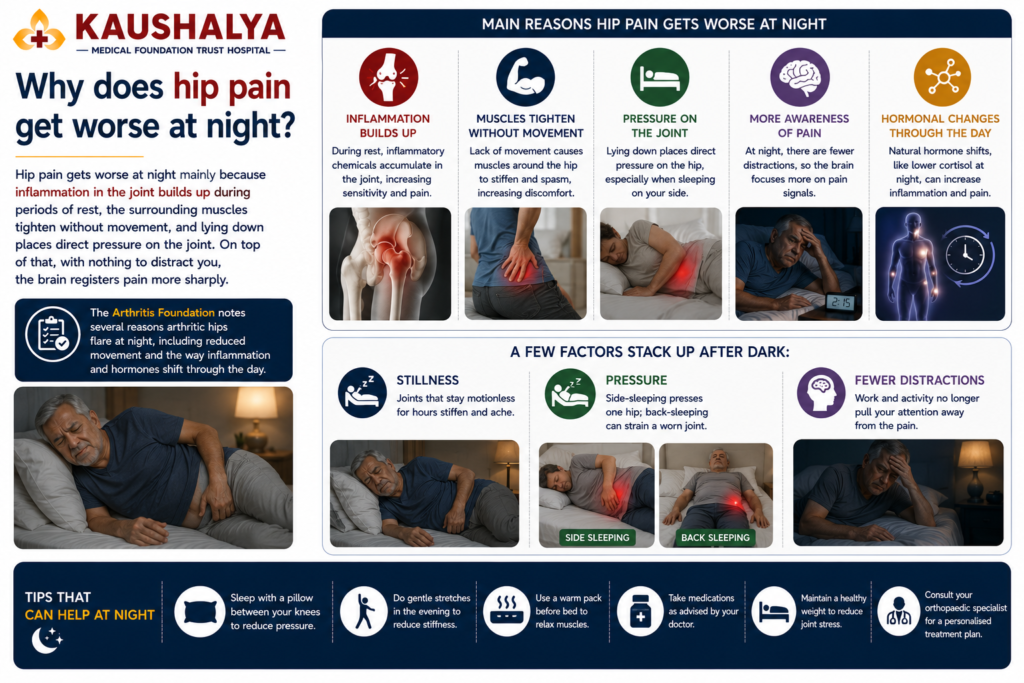
Hip pain gets worse at night mainly because inflammation in the joint builds up during periods of rest, the surrounding muscles tighten without movement, and lying down places direct pressure on the joint. On top of that, with nothing to distract you, the brain registers pain more sharply.
The Arthritis Foundation notes several reasons arthritic hips flare at night, including reduced movement and the way inflammation and hormones shift through the day.
A few factors stack up after dark:
- Stillness: joints that stay motionless for hours stiffen and ache.
- Pressure: side-sleeping presses one hip; back-sleeping can strain a worn joint.
- Fewer distractions: work and activity no longer pull your attention away from the pain.
Is night hip pain a sign of arthritis?
Yes, pain that regularly disturbs your sleep is one of the clearest signs that hip arthritis has moved beyond the mild stage. Early arthritis usually hurts with activity and settles at rest, so when rest and night-time stop giving relief, the joint has typically worn further.
That does not automatically mean surgery is near. It does mean the arthritis deserves a proper look rather than another month of over-the-counter painkillers.
Night pain is significant precisely because it reflects constant, low-grade inflammation in a joint that no longer calms down just because you have stopped moving.
What sleeping positions and habits help hip pain?
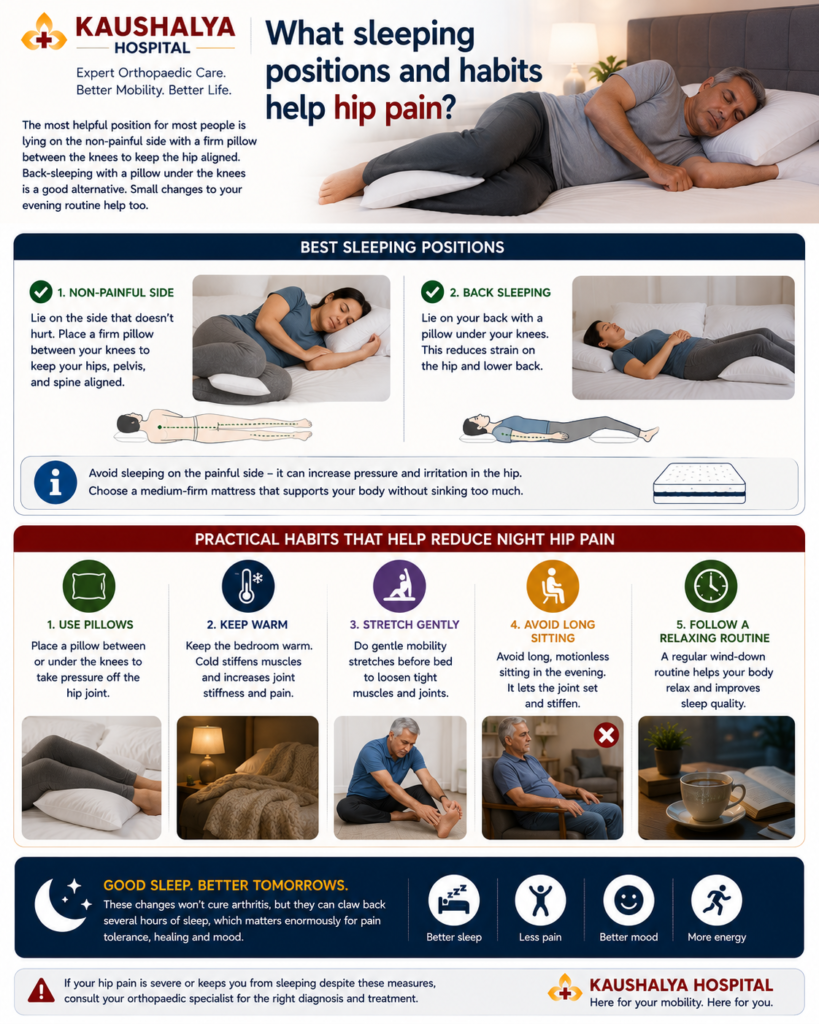
The most helpful position for most people is lying on the non-painful side with a firm pillow between the knees to keep the hip aligned. Back-sleeping with a pillow under the knees is a good alternative. Small changes to your evening routine help too.
Practical steps that often reduce night pain:
- Place a pillow between or under the knees to take pressure off the joint.
- Keep the bedroom warm, as cold stiffens an arthritic hip.
- Do gentle mobility stretches before bed to loosen tight muscles.
- Avoid long, motionless sitting in the evening, which lets the joint set.
These will not cure arthritis, but they can claw back several hours of sleep, which matters enormously for pain tolerance and mood.
When should night hip pain worry you?
Night hip pain should worry you when it is constant, wakes you repeatedly, or comes with your hip visibly limiting your walking and balance during the day. Persistent rest pain is a marker of significant joint damage, not a minor grumble.
There is a safety angle that is easy to miss. Research shows that hip osteoarthritis symptoms are linked to a higher risk of falls in older adults, because a painful, stiff hip affects balance and confidence on your feet. So a hip that steals your sleep and unsteadies your walking is worth acting on, not enduring.
Seek prompt assessment if night pain is joined by fever, sudden severe pain, or an inability to bear weight, which can point to problems needing urgent attention.
What are the treatment options, and when is surgery needed?
Treatment starts conservatively with weight management, physiotherapy, activity changes, and pain relief, and moves towards surgery only when these no longer control the pain. Most people spend a long time in the non-surgical stage.
The usual ladder looks like this:
- First line: exercise, weight control, physiotherapy, and simple analgesia.
- Next: activity modification and, in some cases, injections for flares.
- When needed: joint replacement, once pain and stiffness dominate daily life.
If night pain has become relentless and daytime function is slipping, it is reasonable to discuss hip replacement surgery in Mumbai with the experienced orthopaedic team at Kaushalya Hospital. A modern hip replacement is highly effective at relieving exactly this kind of constant, sleep-wrecking pain.
Frequently asked questions
Does hip arthritis always cause night pain? No. Early hip arthritis usually hurts with activity and eases at rest. Night pain tends to appear as the joint wears further and inflammation becomes more constant. Its arrival is a useful signal that the arthritis has progressed and should be reassessed.
Can changing my mattress help night hip pain? It can help. A mattress that is too soft lets the hips sink and misalign, while one that is too firm adds pressure on the joint. A medium-firm mattress plus a pillow between the knees suits most people with hip arthritis best.
Why does my hip hurt more in bed than when walking? Because movement keeps an arthritic joint warm and lubricated, while lying still lets inflammation and stiffness build. Direct pressure from your sleeping position adds to it, and with no distractions the pain feels more intense than during a busy day.
Will a hip replacement stop the night pain? For most people, yes. Constant rest and night pain from a worn hip is one of the symptoms that responds best to joint replacement, because the arthritic surfaces causing the inflammation are removed. Your surgeon can advise whether you are at that stage.
What can I take for hip pain at night? Simple pain relief recommended by your doctor can help in the short term, but it treats the symptom, not the cause. If you are relying on nightly painkillers to sleep, that itself is a reason to have the hip properly assessed rather than self-managing indefinitely.
Trusted orthopaedic care for hip pain in Thane
Because night pain often signals that arthritis has advanced, it is worth an expert eye rather than another round of guesswork. Kaushalya Hospital combines experienced joint replacement surgeons, on-site diagnostics, and full rehabilitation support, so assessment and treatment happen in one coordinated place.
The aim is always to keep you comfortable with conservative care for as long as it works, and to offer a well-planned hip replacement only when the pain and loss of function justify it. You get an honest read on where your hip stands.
Losing sleep to hip pain is not something you have to accept as part of getting older. If your hip is keeping you awake and slowing you down, get it properly assessed. Book a consultation and find out what is driving the pain and how to settle it.