

Medically reviewed by a consultant orthopaedic and joint replacement surgeon.
Summary: Delaying knee replacement surgery lets osteoarthritis keep wearing away cartilage and bone, weakens the muscles around the joint, and makes the eventual operation harder with a slower recovery. Waiting rarely improves an arthritic knee. For advanced arthritis, a well-timed knee replacement, increasingly a robotic knee replacement, restores movement and lasts for decades. This guide explains the real risks of putting it off.
If your knee arthritis has reached the point where surgery has been suggested, it is tempting to wait. Maybe the pain is bearable on good days, or the timing is never quite right.
But an arthritic knee does not hold steady while you decide. It keeps changing, and usually not for the better. Understanding what actually happens during that waiting period, and where modern options like robotic knee replacement surgery in Mumbai fit in, helps you make the decision on facts rather than fear.
Does knee osteoarthritis get worse if you wait?
Yes. Knee osteoarthritis is a progressive condition, so once the cartilage protecting the joint starts breaking down, it does not pause or repair itself. Waiting almost always means more damage, not less.
As the cartilage thins, the bones begin to rub directly against each other. That worsens inflammation, stiffens the joint, and can gradually bend the knee out of its natural alignment.
A knee that has become bowed or knock-kneed is harder to correct than one caught earlier. So the “wait and see” approach quietly raises the difficulty of the very surgery you are trying to avoid.
What does delaying do to your muscles and mobility?
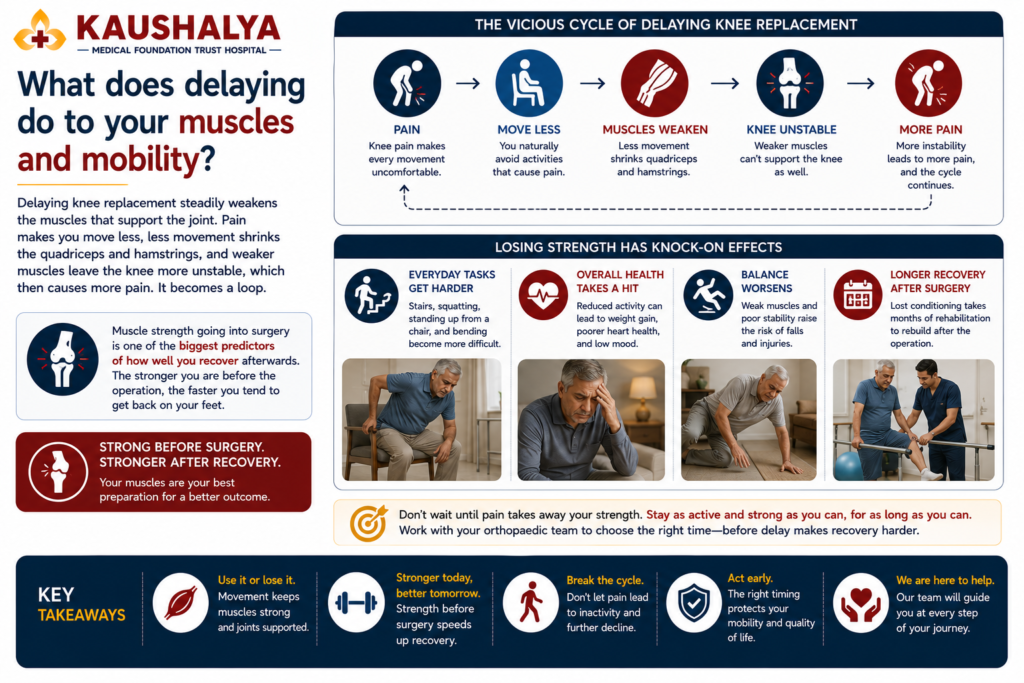
Delaying knee replacement steadily weakens the muscles that support the joint. Pain makes you move less, less movement shrinks the quadriceps and hamstrings, and weaker muscles leave the knee more unstable, which then causes more pain. It becomes a loop.
This matters because muscle strength going into surgery is one of the biggest predictors of how well you recover afterwards. The stronger you are before the operation, the faster you tend to get back on your feet.
Losing that strength has knock-on effects:
- Everyday tasks like stairs, squatting, or getting out of a chair get harder.
- Reduced activity affects weight, heart health, and mood.
- Balance worsens, raising the risk of falls.
By the time some patients finally decide, they have lost conditioning that takes months of rehabilitation to rebuild.
Does waiting make the surgery and recovery harder?
Often, yes. A joint that has been left to deteriorate can mean a more complex operation, because the surgeon may have to correct deformity, release tight tissues, and work around weakened bone. More complexity can mean a longer, harder rehabilitation.
There is also a general health angle. The longer you live with chronic pain and low activity, the more your overall fitness can slip, and being less fit at the time of surgery is linked to a slower recovery.
None of this means surgery becomes impossible. It means the easiest, most predictable version of your operation is usually the one done at the right time, not years later.
How does robotic knee replacement change the decision?
Robotic knee replacement uses a computer-guided system to plan and position the implant with a high degree of precision, which improves how well the new joint is aligned and balanced. Better alignment tends to translate into smoother movement and a more natural-feeling knee.
The measured differences are real. In pooled research comparing the two approaches, robotic-assisted knee replacement achieved a range of motion of about 119 degrees at one year versus roughly 107 degrees for conventional surgery. That extra movement can be the difference between comfortable stairs and cautious ones.
Durability is no longer the worry it once was either. Long-term registry data shows that around 82% of total knee replacements are still working well at 25 years. A modern knee replacement, planned carefully, is built to last most patients the rest of their lives. That reliability is a strong argument against endless waiting, and it is why many patients now specifically seek out robotic knee replacement in Mumbai for their procedure.
When is the right time to have a knee replacement?
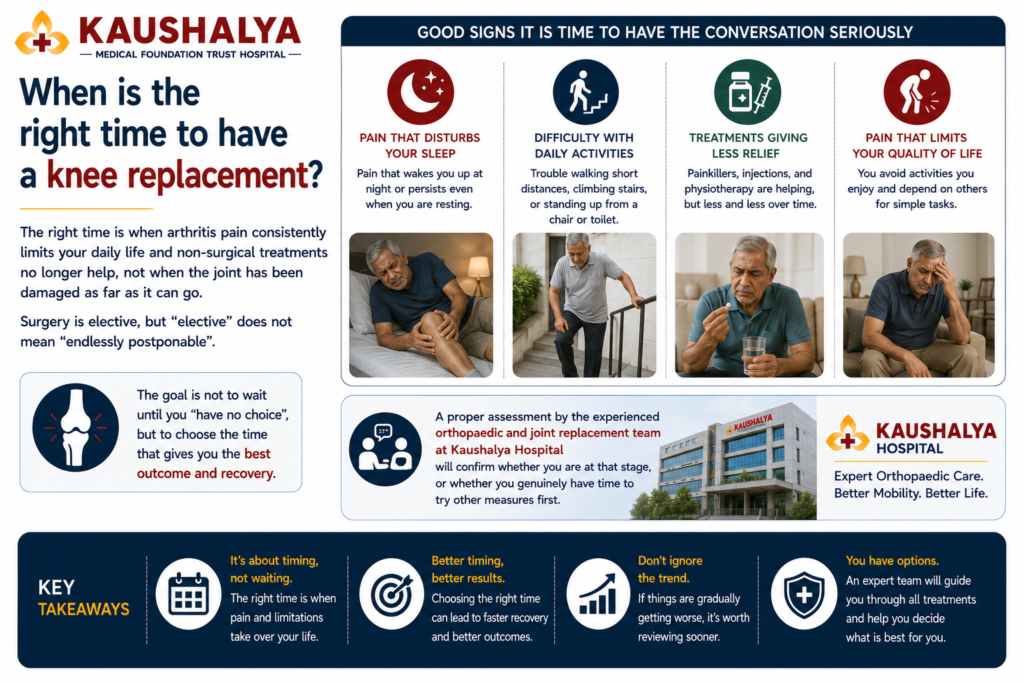
The right time is when arthritis pain consistently limits your daily life and non-surgical treatments no longer help, not when the joint has been damaged as far as it can go. Surgery is elective, but “elective” does not mean “endlessly postponable”.
Good signs it is time to have the conversation seriously include:
- Pain that disturbs your sleep or persists at rest.
- Difficulty walking short distances, climbing stairs, or standing up.
- Painkillers, injections, and physiotherapy giving less and less relief.
A proper assessment by the experienced orthopaedic and joint replacement team at Kaushalya Hospital will confirm whether you are at that stage, or whether you genuinely have time to try other measures first.
Frequently asked questions
Is it ever too late for a knee replacement?
Rarely, but delaying makes it harder. Severe deformity, bone loss, and muscle wasting can complicate the surgery and slow recovery. Most people can still have a successful knee replacement, though an earlier, well-timed operation usually gives a smoother result.
Can exercise or injections replace surgery for advanced arthritis?
No, not for advanced osteoarthritis. Exercise, weight management, and injections help earlier stages and can delay surgery safely. Once cartilage is largely gone and pain is constant, these measures only manage symptoms rather than fix the underlying joint damage.
Does waiting make recovery longer?
Usually, yes. Waiting weakens the muscles around the knee and can stiffen the joint, so rehabilitation starts from a lower baseline. Patients who keep active and strong before surgery generally recover faster than those who have deconditioned over years of avoidance.
What is the advantage of robotic knee replacement?
Robotic knee replacement improves the precision of implant alignment and soft-tissue balance. Studies link it with better range of motion and a more natural-feeling joint. It does not replace surgical skill, but it gives an experienced surgeon a more accurate, personalised plan.
How long will a knee replacement last?
Most modern knee replacements last a very long time, with registry data showing roughly 82% still functioning at 25 years. Sensible activity, healthy weight, and following your rehabilitation programme all help your new joint last as long as possible.
Trusted orthopaedic and joint replacement care in Thane
Because a knee replacement is a decision you make once, the team performing it matters as much as the technology. Kaushalya Hospital brings together experienced joint replacement surgeons, modern operating theatres, and a full critical-care and rehabilitation setup under one roof.
The approach is diagnosis-first: a proper assessment of your arthritis, your general health, and your goals, followed by an honest discussion of whether surgery is warranted now or later. Patients receive a clear plan rather than pressure, with robotic-assisted options available where they add real value.
An arthritic knee will not get better on its own, but you do not have to keep living around it. If pain is shrinking your world, get a clear, expert opinion on your options and the right timing. Schedule an appointment with the orthopaedic team today.