

Medically reviewed by a consultant orthopaedic and joint replacement surgeon.
Summary: Hip arthritis usually feels like a deep ache in the groin or outer hip that is worse with walking and stiff after rest. It can radiate into the buttock, thigh, or even the knee, and slowly limits everyday movements like putting on socks. Most people manage it for years before hip replacement surgery in Thane becomes the right step. This guide explains what to feel for and when to act.
Hip arthritis rarely announces itself. It tends to start as a niggle after a long walk, then becomes a stiffness you notice getting out of the car, and only later a pain that shapes your day.
Knowing what osteoarthritis of the hip actually feels like helps you tell it apart from a muscle strain or back problem, and helps you judge when it is time to get it properly assessed rather than simply pushing through.
What does hip arthritis actually feel like?
Hip arthritis most often feels like a deep, aching pain in the groin or the front of the hip, which worsens when you walk, climb stairs, or stand up after sitting. Many people also describe stiffness, a grinding sensation, and a hip that feels like it is “seizing up”.
The classic pattern is pain that eases with rest early on, then gradually starts appearing during rest too. According to NHS guidance on hip osteoarthritis, the main symptoms are pain and stiffness in the joint that make movement harder, often worse after activity.
It is not always dramatic. For many people it is simply that walking gets slower, shorter, and more careful over months and years.
Where exactly is hip arthritis pain felt?
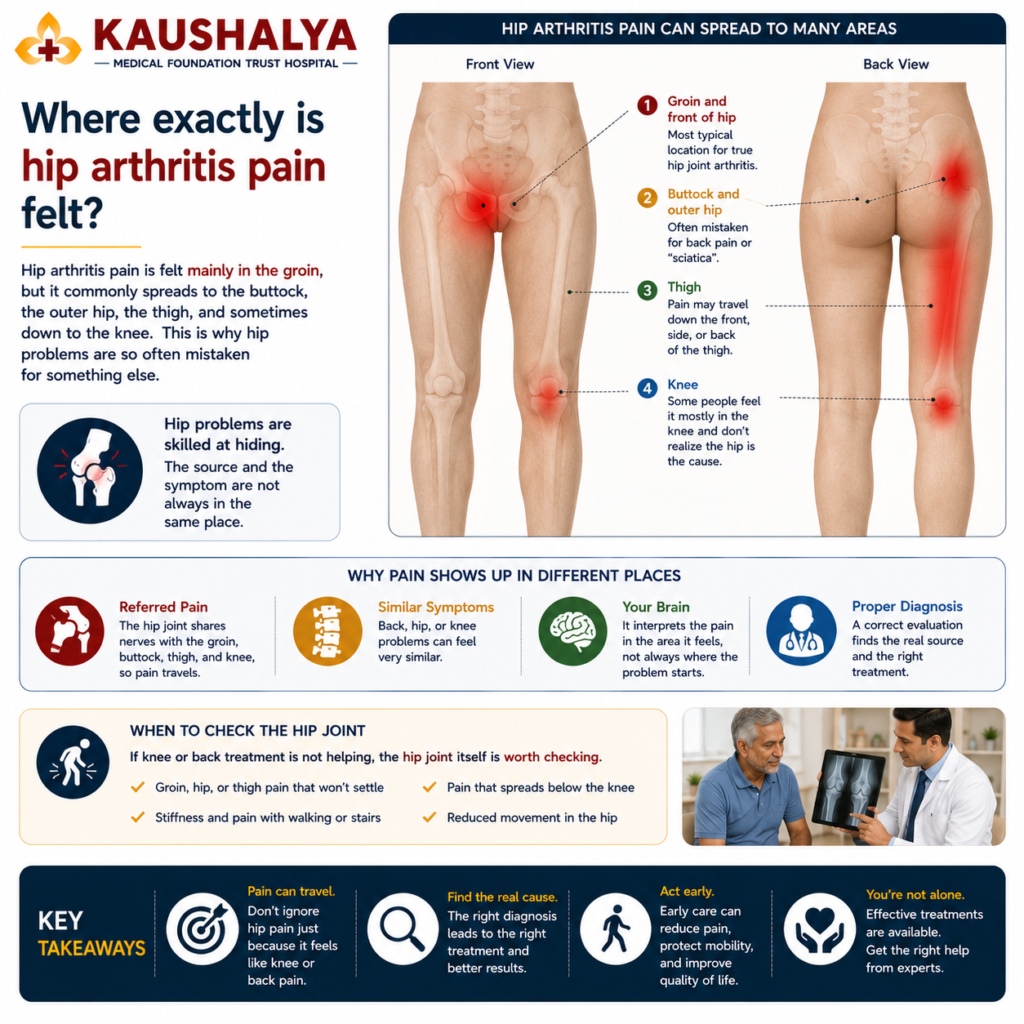
Hip arthritis pain is felt mainly in the groin, but it commonly spreads to the buttock, the outer hip, the thigh, and sometimes down to the knee. This is why hip problems are so often mistaken for something else.
The referred pain trips people up:
- Groin and front of hip: the most typical location for true hip joint arthritis.
- Buttock and outer hip: frequently blamed on the back or on “sciatica”.
- Thigh and knee: some people feel it mostly in the knee and are surprised the hip is the cause.
If knee or back treatment is not helping, the hip joint itself is worth checking, because the source and the symptom are not always in the same place.
What are the early signs before you need surgery?
The early signs of hip arthritis are morning stiffness that eases within about half an hour, a reduced range of movement, and difficulty with tasks that rotate the hip. These appear long before surgery is ever discussed.
Watch for the practical giveaways:
- Struggling to put on socks, shoes, or trousers.
- A slight limp, or leaning to one side when you walk.
- Reduced ability to twist, cross your legs, or get in and out of a car.
- A clicking or catching feeling deep in the joint.
Spotting these early is genuinely useful, because it is the stage where weight management, physiotherapy, and activity changes work best and can delay surgery for years.
How is hip arthritis diagnosed?
Hip arthritis is diagnosed through a clinical examination of how the joint moves combined with an X-ray to look for cartilage loss and bony changes. Neither on its own tells the whole story, which is why both matter.
The picture can be surprising. Research on patients presenting to primary care found that hip pain and X-ray evidence of osteoarthritis do not always line up, with some painful hips showing little on imaging and some worn joints causing few symptoms. A skilled assessment reads the joint and the person together, not just the scan.
That is also why self-diagnosis is unreliable. An experienced examiner can distinguish hip arthritis from bursitis, tendon problems, or referred back pain, and target treatment accordingly.
When does hip arthritis need replacement surgery?
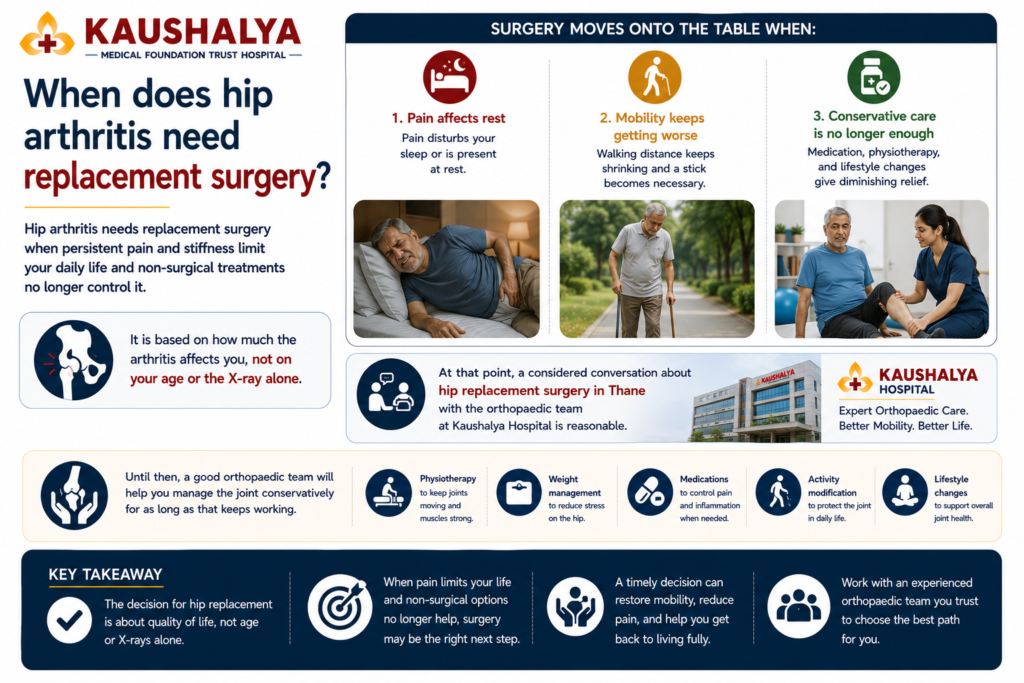
Hip arthritis needs replacement surgery when persistent pain and stiffness limit your daily life and non-surgical treatments no longer control it. It is based on how much the arthritis affects you, not on your age or the X-ray alone.
Surgery moves onto the table when:
- Pain disturbs your sleep or is present at rest.
- Walking distance keeps shrinking and a stick becomes necessary.
- Medication, physiotherapy, and lifestyle changes give diminishing relief.
At that point, a considered conversation about hip replacement surgery in Thane with the orthopaedic team at Kaushalya Hospital is reasonable. Until then, a good orthopaedic team will help you manage the joint conservatively for as long as that keeps working.
Frequently asked questions
How do I know if my pain is hip arthritis or something else? Hip arthritis typically causes groin pain that worsens with walking and stiffness after rest. Back or nerve problems more often cause pain running down the leg with tingling. Only a proper examination and X-ray can reliably tell them apart, so get it assessed.
Can hip arthritis be treated without surgery? Yes, especially in early and moderate stages. Weight management, targeted exercise, physiotherapy, pain relief, and activity changes can control symptoms for years. Surgery becomes the option only once the joint is badly worn and these measures stop giving meaningful relief.
Does hip arthritis pain come and go? Early on, yes. It often flares after activity and settles with rest, which is why people delay seeking help. As the cartilage wears further, the pain becomes more constant and starts intruding on rest and sleep, which is a signal to be assessed.
Why do I feel hip arthritis in my knee? The hip joint shares nerve pathways with the thigh and knee, so pain is often referred downwards. It is common to feel hip arthritis mainly as knee or thigh ache. If knee treatment is not helping, the hip is well worth examining.
At what age do people usually get hip replacements? Most hip replacements are done between the ages of 60 and 80, but need is based on symptoms, not age. Younger patients with severe arthritis and older, fit patients can both be excellent candidates once the joint is significantly damaged.
Expert hip and joint care in Thane
Because hip pain is so easily confused with back and knee problems, an accurate diagnosis is half the battle. Kaushalya Hospital offers assessment by experienced orthopaedic surgeons, in-house imaging, and a full surgical and rehabilitation setup, so the whole pathway sits in one place.
The focus is on treating the joint at the right stage: conservative care while it works, and a carefully planned replacement only when it is genuinely needed. Patients get a clear explanation of where their arthritis stands and what the realistic options are.
Hip arthritis is manageable for a long time when you understand it and act sensibly. If a deep groin ache or a stiffening hip is starting to limit you, do not simply live around it. Book a consultation for a proper diagnosis and a plan built around your stage of arthritis.