

Summary
Persistent knee pain is not the only sign. Stiffness, swelling, and night pain also matter. Trouble walking, climbing stairs, or standing is important. If treatment no longer helps, surgery may be discussed. Robotic planning can support more precise joint replacement. Kaushalya Hospital Thane offers local expert evaluation.
Introduction
Knee pain often starts slowly. It may come and go at first. But when pain begins shaping daily life, it needs attention. That is where many people start asking about robotic knee replacement surgery in mumbai.
The real warning sign is not just pain. It is pain that keeps returning. It is pain that changes how you move, rest, and work.
This guide explains the signs clearly. It also shows when medical advice becomes important. You will learn how doctors judge the need for surgery.
What warning signs suggest the knee may need replacement?
Pain alone does not always mean replacement. Doctors look at the full pattern.
Common signs that matter
- Pain during walking or standing
- Stiffness after sitting too long
- Swelling that keeps coming back
- Difficulty using stairs
- Pain at night or during rest
- A knee that feels weak or unstable
- Reduced ability to bend or straighten fully
These signs often appear together. When they do, daily life becomes harder.
You may also notice small changes. You stop going on long walks. You avoid stairs. You sit down more often. These are not minor changes.
They show the knee is limiting your routine. That is often when people start exploring robotic knee replacement in mumbai.
How do doctors decide if surgery is the right step?
A doctor does not recommend surgery based on one symptom. The decision is broader.
They usually consider your pain level, movement, and response to treatment. They also check scans and physical findings. These help show how much the joint has worn down.
What doctors usually review
- How far the pain has progressed
- Whether medicines still help
- Whether physiotherapy gives relief
- How much the knee bends and straightens
- Whether the joint looks damaged on imaging
- Whether your walking pattern has changed
If non-surgical care no longer works, surgery may be discussed. That is often the point where robotic knee replacement surgery in mumbai enters the conversation.
A good evaluation should feel practical, not rushed. You should understand why surgery is being suggested.
When is surgery better than more treatment?
Not every painful knee needs replacement. Some still respond to non-surgical care.
Non-surgical treatment may still help when:
- Pain comes only after heavy activity
- Stiffness is mild
- Walking is still manageable
- Medicines still bring relief
- Physiotherapy improves movement
Surgery becomes more likely when:
- Pain is present even at rest
- Sleep is disturbed often
- Walking is becoming shorter and slower
- The knee is visibly weak or bent
- Relief from treatment is temporary only
Think of it this way. If your treatment gives short relief, but symptoms return quickly, the knee may be worsening.
That is when robotic knee replacement in mumbai may be worth discussing with an orthopaedic specialist.
| Situation | More likely choice |
| Mild pain with activity | Continue non-surgical care |
| Pain with stiffness and swelling | Medical review needed |
| Pain at rest and sleep loss | Surgery discussion may begin |
| Severe movement loss | Replacement may be considered |
This is not about fear. It is about function. The key question is simple. Can you live normally, or not?
How does robotic surgery help in knee replacement?
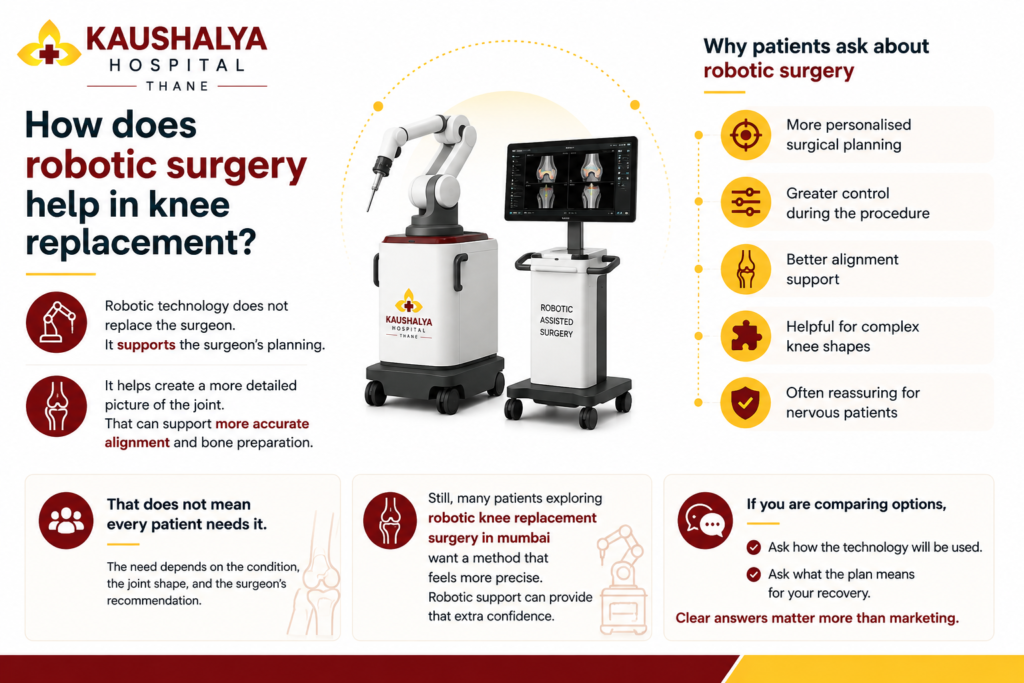
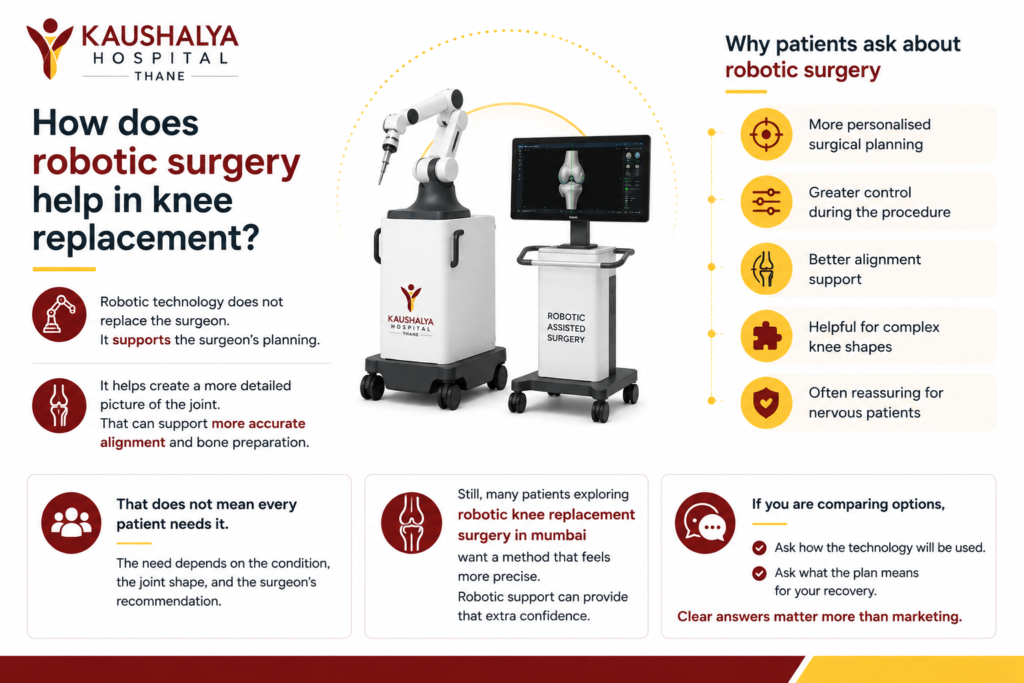
Robotic technology does not replace the surgeon. It supports the surgeon’s planning.
It helps create a more detailed picture of the joint. That can support more accurate alignment and bone preparation.
Why patients ask about robotic surgery
- More personalised surgical planning
- Greater control during the procedure
- Better alignment support
- Helpful for complex knee shapes
- Often reassuring for nervous patients
That does not mean every patient needs it. The need depends on the condition, the joint shape, and the surgeon’s recommendation.
Still, many patients exploring robotic knee replacement surgery in mumbai want a method that feels more precise. Robotic support can provide that extra confidence.
If you are comparing options, ask how the technology will be used. Ask what the plan means for your recovery. Clear answers matter more than marketing.
Why does local care matter in Mumbai and Thane?
Knee replacement is not just about surgery day. It is about follow-up, comfort, and rehabilitation.
That is why local access matters. If you live in Thane or nearby Mumbai, treatment close to home reduces travel strain. It also makes review visits easier.
Kaushalya Hospital Thane is positioned well for patients who want nearby orthopaedic care. That convenience can matter a lot during recovery.
Local treatment helps with:
- Easier pre-surgery consultations
- Simple access for follow-up visits
- Better support during recovery
- Less travel stress for older patients
- Family involvement in care
People often search for robotic knee replacement in mumbai because they want advanced care nearby. That is a sensible approach when surgery and recovery both need attention.
A local specialist can also check whether your symptoms truly justify replacement. That step is crucial before deciding.
How can you decide whether the time has come?
Use function as your guide. Ask what your knee no longer lets you do.
If you cannot walk comfortably, sleep well, or manage stairs, the knee may be affecting quality of life too much. If pain keeps returning after treatment, that also matters.
Questions worth asking yourself
- Is the pain getting worse, not better?
- Do I avoid normal movement?
- Has sleep become uncomfortable?
- Does the knee feel unstable?
- Are injections, medicine, or therapy failing?
If the answer is yes to several of these, consult a specialist. You may not need surgery immediately. But you do need clarity.
That is where robotic knee replacement surgery in mumbai may become part of a serious treatment discussion.
FAQ
How do I know if my knee pain is severe enough for replacement?
If pain affects walking, sleeping, stairs, or daily tasks, it is serious. Doctors also check scans, movement, and how well other treatments still work.
Can physiotherapy still help before surgery?
Yes, if movement is still possible and pain is manageable. But if therapy only gives brief relief, a specialist should reassess the knee.
Is robotic surgery always needed for knee replacement?
No. It is a tool, not a requirement. Your doctor will decide whether robotic support adds value in your case.
Why do people search for robotic knee replacement in mumbai?
They often want advanced planning, local access, and specialist care. It is a practical search for patients comparing treatment options in the city.
Conclusion
Knee replacement becomes a serious consideration when pain stops being occasional and starts limiting life. Stiffness, swelling, sleep loss, and poor response to treatment all matter.
If you are noticing those signs, do not ignore them. A proper orthopaedic review can show whether you still need conservative care or should discuss surgery.
For people exploring robotic knee replacement surgery in mumbai or robotic knee replacement in mumbai, Kaushalya Hospital Thane offers a local place to begin that conversation. Talk to an expert and take the next step with confidence.