

By Kaushalya Medical Foundation Trust Hospital | Medically reviewed by a consultant orthopaedic surgeon
Knee replacement surgery in Thane, like everywhere else, works well for the large majority of people who have it. It also has a complication profile, and most hospital pages reduce that to one reassuring paragraph. This one does not. Below are the things that go wrong, the published figures where defensible figures exist, and a plain statement where they do not.
Key insights
- Revision is uncommon but not rare: national registry data puts ten year implant survival in the mid nineties, which means a small but real proportion need further surgery.
- Dissatisfaction is the biggest complication nobody counts: a knee can be technically perfect and still leave the patient unhappy, and registries do not capture that.
- Infection is the complication that changes everything: it is uncommon, it is the leading reason for revision, and it is the one worth understanding in detail.
- Some risk is yours to move: weight, diabetes control, smoking and dental health all sit on your side of the table, and all of them are modifiable before surgery.
Before you are reassured
There is a difference between a surgeon saying “complications are rare” and a surgeon telling you which ones, how often, what they would do about each, and what your own risk factors add. Ask for the second version. Being told the risks properly is not a bad sign about the hospital, it is a good one.
Most people considering a knee replacement have already read a dozen pages telling them the operation is safe and life changing. Both of those things are true. The trouble is that a page which only says that leaves the anxious reader with nowhere to go, so they end up on forums at midnight reading the worst individual stories on the internet and calibrating their fear against them.
The useful middle ground is numbers with sources attached. So here is the caveat that has to come first: almost all of the good long term data on knee replacement comes from national registries in the United Kingdom, Scandinavia, Australia and the United States. India does not yet have a comparable national joint registry with published long term outcomes. The figures below are therefore international, and should be read as the general shape of the risk rather than as this hospital’s results.
Why hospital pages do not usually carry this
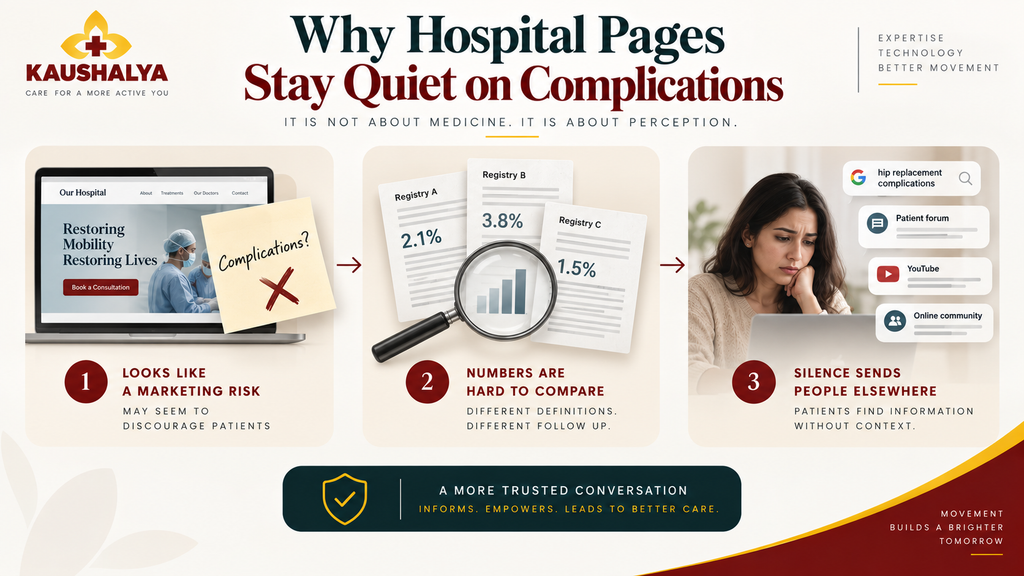
Complications read as a marketing problem
A page that lists what can go wrong looks, on the face of it, like a page that discourages surgery. In practice it is the page patients actually search for, and the one they trust.
The numbers are genuinely awkward to quote
Different registries define complications differently, follow up for different lengths of time, and count revisions rather than symptoms. Two honest sources can produce two different figures for the same thing.
Silence sends people somewhere worse
If a hospital will not discuss the risk, the patient finds the information anyway, without context and without anyone to interpret it.
The numbers at a glance
| Complication | What the published data says | Source basis |
| Implant survival at ten years | Reported in the mid nineties per cent, giving a ten year revision rate of a few per cent | UK national registry data as cited in a systematic review |
| Revision for infection at ten years | 0.75 per cent of primary knee replacements | England and Wales registry analysis |
| Revision for infection within two years | Around 3.2 per 1,000 after a primary knee replacement, rising to 14.4 per 1,000 after a revision | Same registry analysis |
| Infection as a share of all revisions | Roughly a third of revision knee replacements | American registry data, 2012 to 2023 |
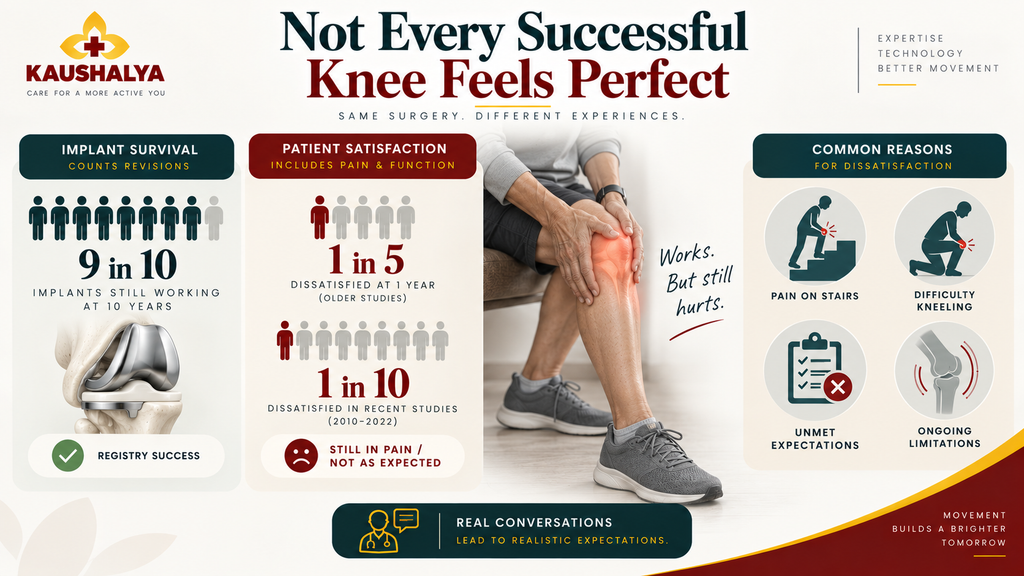
| Patient dissatisfaction at one year | Widely quoted as about 20 per cent, with a more recent review putting the average nearer 10 per cent | Two systematic reviews, see below |
| Stiffness requiring manipulation | Reported in low single figures but varies substantially between series | No single defensible figure, see note |
| Blood clots, nerve and vessel injury, periprosthetic fracture | Uncommon, and rates differ too widely between populations and prophylaxis protocols to quote one number honestly | No single defensible figure, see note |
Those last two rows are deliberate. A number that cannot be sourced properly does not belong on a hospital page, and the alternative to guessing is saying so.
Persistent pain and dissatisfaction
The complication that does not appear in the survival data
An implant that is never revised counts as a success in a registry. It counts as a success to the surgeon. It does not necessarily count as a success to a patient who still cannot kneel, still has an ache on stairs, and expected more.
What the reviews actually say
A systematic review of dissatisfaction after total knee replacement discusses the widely cited figure of roughly one in five patients dissatisfied at a year, and makes the important point that survival analysis understates poor function and pain because those problems do not always lead to revision and so never get recorded.
A more recent review, titled Are 20% of Patients Actually Dissatisfied Following Total Knee Arthroplasty, examined the literature from 2010 to 2022 and found an average dissatisfaction rate closer to 10 per cent, which suggests the older figure may overstate the current position.
Where it comes from
Unmet expectations account for a large share of it. Patients told they will get a normal knee back are more likely to be disappointed than patients told they will get a considerably less painful knee with some permanent limitations. Kneeling, in particular, is often difficult afterwards and is frequently not discussed beforehand.
Infection
Why it is the one to understand
Periprosthetic joint infection is uncommon, but it is the leading reason knee replacements get revised. Registry analysis covering more than 1.5 million primary and revision cases reports infection as the most common indication for revision knee arthroplasty, at around a third of all revisions in the period studied.
The figures
An analysis of the National Joint Registry for England, Wales, Northern Ireland and the Isle of Man put the ten year rate of revision for prosthetic joint infection after knee replacement at 0.75 per cent, with the two year incidence at 3.2 per 1,000 after a primary knee replacement and 14.4 per 1,000 after a revision. The jump between those last two numbers is the clearest argument there is for getting the first operation right.
What it means in practice
Early infection may be treatable with washout and antibiotics while keeping the implant. Established infection generally means the implant comes out, an antibiotic spacer goes in, and a second operation follows months later. This is why prevention, including dental clearance and diabetes control before surgery, is taken so seriously.
Stiffness
What it looks like
A knee that will not bend far enough to use stairs comfortably or get in and out of a car, usually becoming apparent in the first six to twelve weeks.
Why it happens
Scar tissue inside the joint, pain limiting early movement, or inadequate physiotherapy in the first crucial weeks. Some patients are simply prone to forming scar tissue.
What is done about it
Manipulation under anaesthesia, where the knee is bent under general anaesthetic to break down adhesions, is the usual response and is most effective when done early. Published rates vary too much between series for a single honest figure, but it is a recognised and manageable problem rather than a rare disaster.
When complications tend to appear
Most of the risk sits in the first three months
Complications are not spread evenly across the recovery. Wound and clot risk is front loaded, stiffness declares itself in the middle weeks, and dissatisfaction only becomes clear once the swelling has gone and you have tried to return to normal life.
| Period | What is being watched for |
| First 48 hours | Bleeding, anaesthetic complications, pain control, early mobilisation |
| First 2 weeks | Wound problems, early infection, blood clots |
| Weeks 2 to 12 | Stiffness, delayed wound healing, clot risk continuing |
| 3 to 12 months | Persistent pain, dissatisfaction, ongoing swelling |
| 1 year onwards | Loosening, wear, late infection, periprosthetic fracture after a fall |
What moves your personal risk
The preparation window is worth more than most people give it
Your surgeon controls the operation. You control most of the list below, and you control it in the weeks before admission rather than afterwards.
| Factor | Direction | Can you change it before surgery |
| Obesity | Raises infection and wound healing risk | Partly, and even modest loss helps |
| Poorly controlled diabetes | Raises infection risk substantially | Yes, and this is the single highest value preparation |
| Smoking | Impairs wound healing | Yes, stopping weeks before surgery matters |
| Untreated dental infection | A recognised source of bacteria | Yes, dental clearance before surgery |
| Previous knee surgery or infection | Raises complexity and risk | No, but it changes the surgical plan |
| Rheumatoid arthritis and immunosuppression | Raises infection risk | Managed rather than removed, with your physician |
The warning signs to act on
Call early, and do not wait for the next appointment
Every item below is treated far more easily when it is caught in days rather than weeks. Nobody at a hospital minds a phone call that turns out to be nothing.
| Sign | What it may mean | What to do |
| Fever, increasing redness, discharge from the wound | Possible infection | Contact the hospital the same day |
| Calf pain and swelling, or sudden breathlessness | Possible clot | Emergency assessment immediately |
| Range of movement going backwards after week three | Developing stiffness | Call your surgeon, do not wait for the next appointment |
| Sudden new instability or a pop after a fall | Possible fracture or component problem | Imaging, promptly |
How to raise this with your surgeon
The wording that works
“What are your own complication rates, and what in my history raises my personal risk?” That is one question and it asks for two different things, both reasonable.
What a good answer includes
A named set of complications, an acknowledgement of which of your risk factors matter, and a plan for the modifiable ones. Vagueness is the thing to notice, not the numbers themselves.
It is not an accusation
Surgeons who do a lot of this work are entirely comfortable discussing what goes wrong. The conversation tends to be shorter and clearer with the busiest ones.
Wrapping up
Knee replacement is one of the most consistently successful operations in modern medicine, and nothing above changes that. What the figures do change is the conversation you should expect to have before it. The complications worth asking about are infection, because it is the one that reshapes everything, stiffness, because it is the one you can most influence through rehabilitation, and dissatisfaction, because it is the one that never shows up in any registry and is far more common than the others put together.
Kaushalya Medical Foundation Trust Hospital performs knee replacement surgery inside a 150 bed tertiary care hospital in Thane, with five operation theatres, intensive care on site, 24 hour pathology and imaging, and four consultant orthopaedic surgeons in the department.
If you are weighing this decision, bring the questions above to a consultation with the orthopaedic surgery department, and ask about the preoperative work up in patient services while you are there. The preparation window is where most of the modifiable risk actually sits.
FAQs
How often does a knee replacement need to be redone?
National registry data reports ten year implant survival in the mid nineties per cent, so a few per cent of knee replacements are revised within ten years. Younger and more active patients have a higher lifetime likelihood, simply because the implant has longer to serve.
How common is infection after a knee replacement?
Uncommon. One large registry analysis put revision for infection at 0.75 per cent at ten years after a primary knee replacement. The rate after a revision knee replacement is several times higher, which is one reason the first operation matters so much.
Why do some people still have pain after a successful knee replacement?
Because a technically correct implant does not guarantee a satisfied patient. Persistent pain, difficulty kneeling and unmet expectations are all recognised, and none of them are captured by implant survival statistics.
Can I reduce my own risk before surgery?
Yes, and more than most people realise. Getting diabetes well controlled, stopping smoking, clearing dental infection and losing even a modest amount of weight all reduce complication risk, and all of them have to happen before the operation rather than after.
What is manipulation under anaesthesia?
A procedure where a stiff knee is bent under general anaesthetic to break down internal scar tissue. It is used when range of movement stalls in the first few months, and it works considerably better when done early rather than late.
Are Indian complication rates different from these figures?
Possibly, but nobody can say by how much, because India does not yet have a national joint registry publishing comparable long term outcomes. That is why the figures here are labelled by source, and why it is worth asking your own surgeon and hospital for their results.