
By Kaushalya Medical Foundation Trust Hospital | Medically reviewed by a consultant orthopaedic surgeon | 10 min read
Torn ligaments in the knee very often stop hurting long before they are healed, and in partial tears the pain can settle within three to six weeks. The knee then feels usable, so people go back to normal life on a joint that is no longer stable. The damage that follows is not caused by the original tear. It is caused by the months of walking on it.
Key insights
- Pain is a poor test of ligament integrity: a partially torn ligament can settle to almost nothing and still leave the knee mechanically unsound.
- The symptom to watch is giving way, not ache: instability, not pain, is what tells you the ligament is not doing its job.
- Delay has a measurable price: published registry work links longer gaps before ACL reconstruction with higher rates of medial meniscal tears and cartilage damage.
- It is rarely too late to be assessed: even years on, a proper examination changes the plan more often than people expect.
Before you decide you are fine
The knee that swelled up, settled down and now only troubles you on stairs or uneven ground is the exact presentation that gets missed. If your knee has ever given way underneath you without warning, that is a mechanical sign and it deserves an examination, whatever the pain level is doing.
The classic story goes like this. Somebody twists a knee playing cricket, or steps off a kerb badly, or comes off a scooter. It swells, it hurts, they cannot bend it properly for a fortnight. They rest, they ice it, maybe they get an X-ray which shows no fracture, and they are told to take it easy.
Three weeks later it is better. Six weeks later it is more or less normal. They get on with life. And then eighteen months later they are back, with a knee that catches, locks, or has started aching in a way it never did before, and a scan that shows a meniscus in trouble.
The ligament was torn the whole time. It just stopped announcing itself.
Why a torn ligament can stop hurting
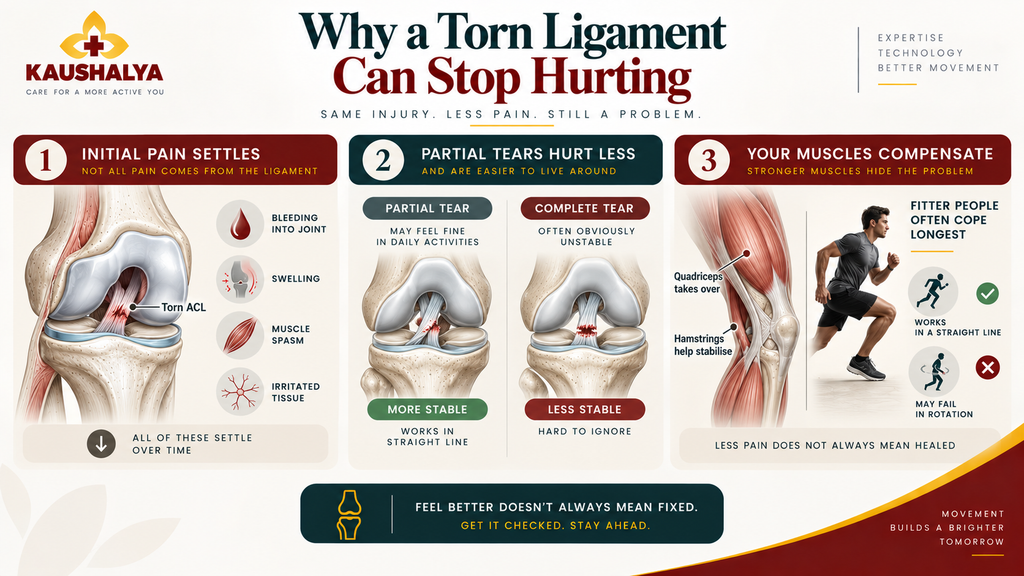
Ligaments have limited pain signalling
The acute pain after a knee injury comes largely from bleeding into the joint, swelling, muscle spasm and irritated surrounding tissue. All of those resolve. The ligament fibres themselves, once the initial inflammation settles, are not generating a constant pain signal.
Partial tears settle better than complete ones, and that is the trap
A completely ruptured ACL often leaves an obviously unstable knee that is hard to ignore. A partial tear can leave a knee that works fine in a straight line and fails only in rotation, which is a far easier thing to live around without realising.
Your muscles compensate, quietly
Quadriceps and hamstrings take over some of the stabilising job. The stronger you were before the injury, the better the compensation and the more convincing the illusion of recovery. Fit people get away with it the longest, which is why fit people often present the latest.
The four ligaments, and which ones go quiet
| Ligament | Where it sits | Typical mechanism | How likely it is to be walked on |
| ACL, anterior cruciate | Centre of the knee | Twisting on a planted foot, landing awkwardly | High, especially partial tears |
| MCL, medial collateral | Inner side | Blow to the outside of the knee | Very high, often heals partially and feels settled |
| LCL, lateral collateral | Outer side | Blow to the inside of the knee | Moderate, less common overall |
| PCL, posterior cruciate | Behind the centre | Direct blow to the front of a bent knee, dashboard injury | Very high, frequently missed entirely |
The PCL is the one people are most surprised by. A posterior cruciate injury from a road accident can produce almost no dramatic symptoms in the early stage, and can go undiagnosed for years.
The grades, and why grade two is the dangerous one
| Grade | What it means | How it usually behaves |
| Grade 1 | Fibres stretched, ligament intact | Settles within weeks, genuinely heals |
| Grade 2 | Partial tear, ligament stretched and weakened | Pain settles, stability does not fully return, this is the one people walk on |
| Grade 3 | Complete tear | Often obviously unstable, though not always in the first weeks |
Grade two is where almost all of the missed injuries sit. It hurts enough to be taken seriously at the time and settles enough to be forgotten about afterwards.
The timeline people actually live
| Stage | What the knee does | What people usually conclude |
| Day 1 to 3 | Swelling, heat, difficulty straightening or bending | Something serious has happened |
| Week 1 to 3 | Swelling subsides, walking improves, no fracture on X-ray | It was a sprain |
| Week 4 to 8 | More or less normal walking, occasional stiffness | It has healed |
| Month 3 to 12 | Odd episodes of giving way on uneven ground, avoidance of sport | I am just being careful |
| Year 1 to 3 | Catching, locking, new aching, swelling after activity | Something new has gone wrong |
Nothing new went wrong. That last row is the meniscus, and it is the bill for the four rows above it.
The signs that are not pain
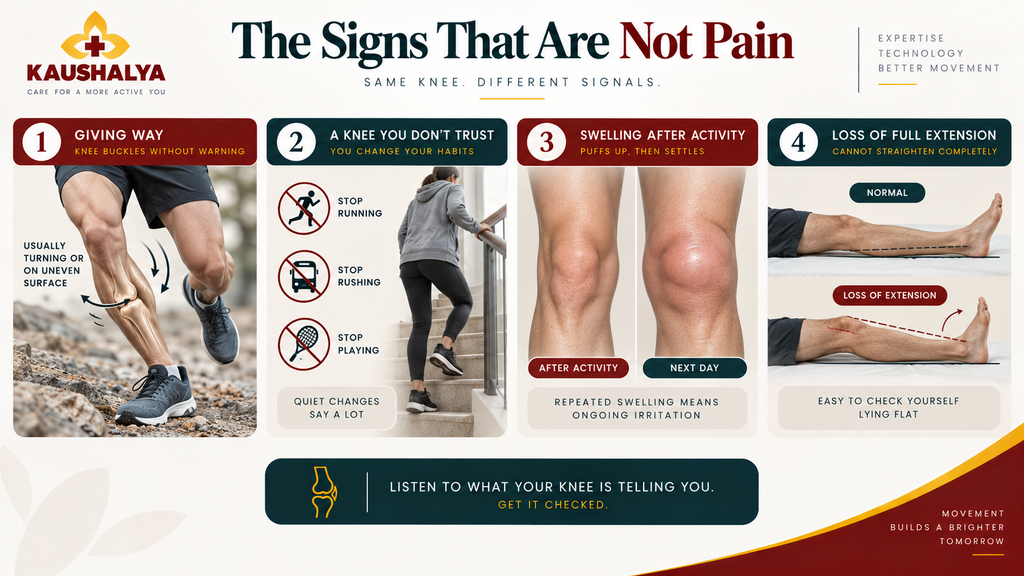
Giving way
The knee buckles without warning, usually turning or on an uneven surface. This is the single most important symptom in the whole article, and it is the one patients most often fail to mention because it does not hurt.
A knee you no longer trust
People change their behaviour around an unstable knee long before they complain about it. They stop stepping down stairs on that leg, they stop running for a bus, they stop playing. If you have quietly dropped an activity, that is data.
Swelling that comes back after activity
A joint that puffs up the day after a long walk or a game, then settles, is telling you it is being irritated by something mechanical.
Loss of full extension
Not being able to straighten the knee completely, especially compared to the other side, is significant and is easy to check yourself lying flat on a bed.
What walking on an unstable knee costs
The meniscus takes the load
The medial meniscus acts as a secondary restraint when the ACL is not working. Every episode of abnormal movement grinds through it. This is the mechanism by which a ligament problem becomes a cartilage problem.
The published picture
A New Zealand ACL registry study found that delay before reconstruction was associated with higher rates of medial meniscal injury and chondral damage, with the risk of a medial meniscal tear requiring partial removal rising substantially once surgery was delayed beyond a few weeks, and higher grade cartilage defects appearing in the longer delay groups.
A separate study of meniscal tear prevalence and type in patients with ACL injury points the same way, reporting a higher incidence of meniscal injury, particularly to the medial meniscus, where reconstruction was delayed beyond three months.
Why this matters more than the ligament itself
A Torn ligament can be reconstructed. A meniscus that has been ground down over two years often cannot be repaired, only trimmed, and a trimmed meniscus raises the long term risk of arthritis in that compartment. The ligament is the reversible injury. The secondary damage is frequently not.
Who this happens to most
Recreational players in their twenties and thirties
Weekend cricket, football and badminton, no formal medical follow up after the injury, and enough fitness to compensate well.
People whose injury came with a bigger event
Road traffic accidents where attention goes to the fracture or the head injury, and the knee is assessed properly only much later.
Anyone told “no fracture” and sent home
An X-ray rules out broken bone. It says nothing at all about ligaments. This single misunderstanding accounts for a large share of missed ligament injuries.
What a proper assessment involves
The examination comes first
Lachman, anterior and posterior drawer, pivot shift, and varus and valgus stress testing at different angles of flexion. An experienced examiner can characterise most ligament injuries with their hands before any scan is ordered.
The MRI confirms and grades
MRI shows the ligament, the menisci and the cartilage together, which is why it is the study that matters here rather than a repeat X-ray. It is confirming and grading, not discovering.
The other knee is part of the test
Ligament laxity varies between individuals. Comparing the injured side to the uninjured side is how an examiner tells a loose knee from a torn one.
Is it too late, years later?
Usually not
Late reconstruction is routinely done and works. What changes is that the surgeon is now also dealing with whatever the meniscus and cartilage have suffered in the interim, so the operation and the rehabilitation are more involved.
Surgery is not automatic
Plenty of people with old ligament injuries do well with a structured strengthening programme and activity modification, particularly if they do not need the knee to cut and pivot. That is a legitimate decision, made properly rather than by default.
The point is to decide on purpose
The problem with walking on a torn ligament for two years is not that surgery was skipped. It is that no decision was ever made at all.
Wrapping up
If your knee swelled up after a twist, settled down, and has since given way on you even once, the absence of pain is not reassurance. It is the normal course of a partially torn ligament, and the cost of assuming otherwise is usually paid by the meniscus rather than by the ligament. Getting examined does not commit you to an operation. It commits you to knowing what you are walking on.
Kaushalya Medical Foundation Trust Hospital runs its orthopaedic surgery service in Thane with four consultant surgeons covering joint replacement, trauma, spine and paediatric orthopaedics, inside a 150 bed tertiary care hospital with 24 hour imaging on site.
If a knee injury from months or years ago has never been properly examined, book a consultation with the orthopaedic team. Radiology and the wider diagnostic set-up are listed under patient services. Bring any old films you have, and mention every episode of giving way, even the ones that did not hurt.
FAQs
Can a torn ligament heal on its own?
Partial tears, particularly of the MCL, often heal well with bracing and rehabilitation. A completely torn ACL does not reattach itself. The knee can still feel normal afterwards, which is why healing and feeling better are not the same thing.
How do I know if my knee ligament is torn without a scan?
You cannot be certain, but giving way, a knee you no longer trust on uneven ground, swelling after activity and an inability to fully straighten the joint are the four signs that should send you for an examination.
Does an X-ray show a torn ligament?
No. X-rays show bone. They are ordered to rule out fracture and they do that job well, but a normal X-ray after a knee injury tells you nothing about the ligaments or the menisci. MRI is the study for soft tissue.
Is it too late to fix a ligament I tore years ago?
Usually not. Late reconstruction is common and effective. The difference is that any meniscal or cartilage damage accumulated in the meantime has to be managed at the same time, which makes the surgery and the rehabilitation larger.
Why does my knee give way but not hurt?
Because instability and pain are different signals. Giving way is a mechanical failure of restraint, which a torn ligament produces even after the inflammation causing the original pain has entirely resolved.
What happens if I just live with an unstable knee?
Many people do, and some do well, particularly if they avoid twisting and pivoting. The risk is progressive meniscal and cartilage damage in the compartment taking the abnormal load, which raises the long term likelihood of arthritis there.