

By Kaushalya Medical Foundation Trust Hospital | Medically reviewed by a consultant orthopaedic surgeon
Searching for an orthopedic doctor in Thane returns dozens of names with near identical qualifications, which is why most people end up picking on distance or on a recommendation from a relative. Orthopaedics is not one job. It splits into at least six working sub-specialties, and the surgeon who is excellent for your shoulder may not be the one you want for your child’s fracture.
Key insights
- Orthopaedics is six or more distinct jobs: joint replacement, arthroscopy and sports, trauma, spine, hand and extremity, and paediatric orthopaedics share a degree and very little else day to day.
- Volume tracks outcome: published work links how many of a procedure a surgeon performs each year with complication rates.
- The qualification letters do not tell you the sub-specialty: MS, DNB and D Ortho tell you about training level, not about what the surgeon actually spends the week doing.
- You can simply ask: how many of my specific operation do you do in a year is the single most useful question available to a patient.
Before you book
Match on the problem, not on the word orthopaedic. If you have a torn meniscus, you want somebody whose week contains arthroscopies. If you have a fractured hip at 78, you want somebody whose week contains hip fractures. These are frequently not the same person, and in a department with several consultants they do not need to be.
The general and specialist distinction gets written about constantly, and it stops in the wrong place. Yes, a specialist orthopaedic surgeon differs from a general physician managing joint pain. But once you are inside orthopaedics, there is a second and more useful layer of sorting, and almost nobody explains it to patients.
That second layer is sub-specialisation. In a large hospital department it determines who does which list, which cases get referred internally between colleagues, and who is called at two in the morning for what. For a patient choosing where to go, it is the difference between a surgeon who does your operation forty times a year and one who does it four times.
What an orthopaedic surgeon actually covers
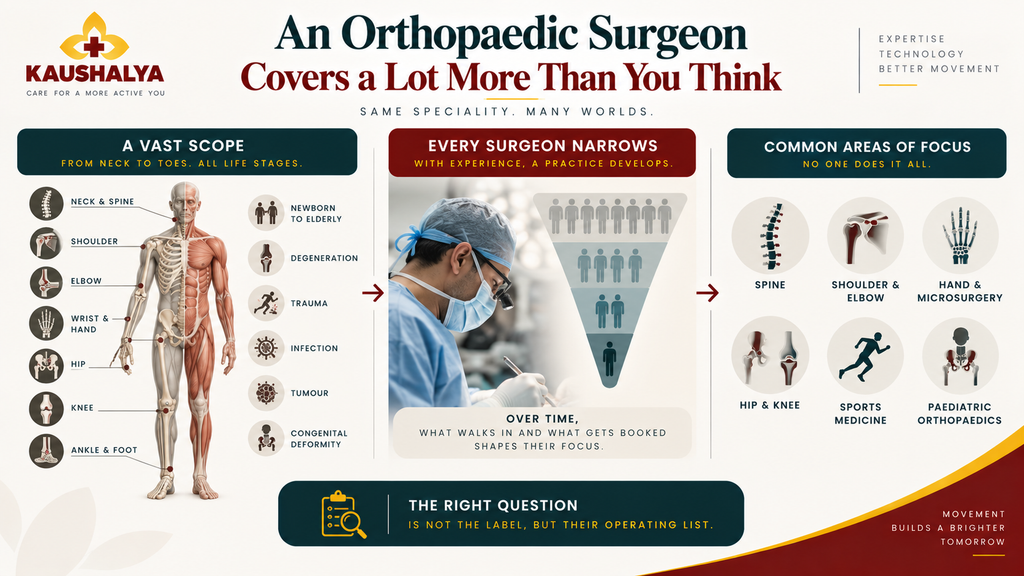
The scope is enormous
Bone, joints, ligaments, tendons, muscles and nerves, from the neck to the toes, from newborns to the very old, across degeneration, trauma, infection, tumour and congenital deformity. No single surgeon practises across all of that at depth.
Every surgeon narrows, whether or not they advertise it
Even surgeons without a formal fellowship label develop a practice. After fifteen years, what walks through the door and what gets booked on the list has shaped them into a sub-specialist in everything but name.
Which means the label is not the point
The useful question is not what their fellowship says. It is what their operating list looks like.
The sub-specialties, in plain language
| Sub-specialty | What it treats | Typical operations |
| Arthroplasty, joint replacement | Worn out hips, knees, shoulders, mainly arthritis | Total and partial knee replacement, total hip replacement, revision surgery |
| Arthroscopy and sports medicine | Ligament, cartilage and tendon injuries in active people | ACL reconstruction, meniscal repair, shoulder stabilisation, rotator cuff repair |
| Trauma | Fractures and acute injury, from road accidents to fragility fractures | Plating and nailing of fractures, external fixation, hip fracture surgery |
| Spine | Neck and back, discs, canal narrowing, deformity, instability | Discectomy, decompression, spinal fusion |
| Hand, and foot and ankle | Small joints and complex tendon and nerve anatomy | Carpal tunnel release, tendon repair, bunion correction, ankle reconstruction |
| Paediatric orthopaedics | Growing bones, congenital deformity, children’s fractures | Clubfoot correction, growth plate injuries, limb deformity correction |
Arthroplasty
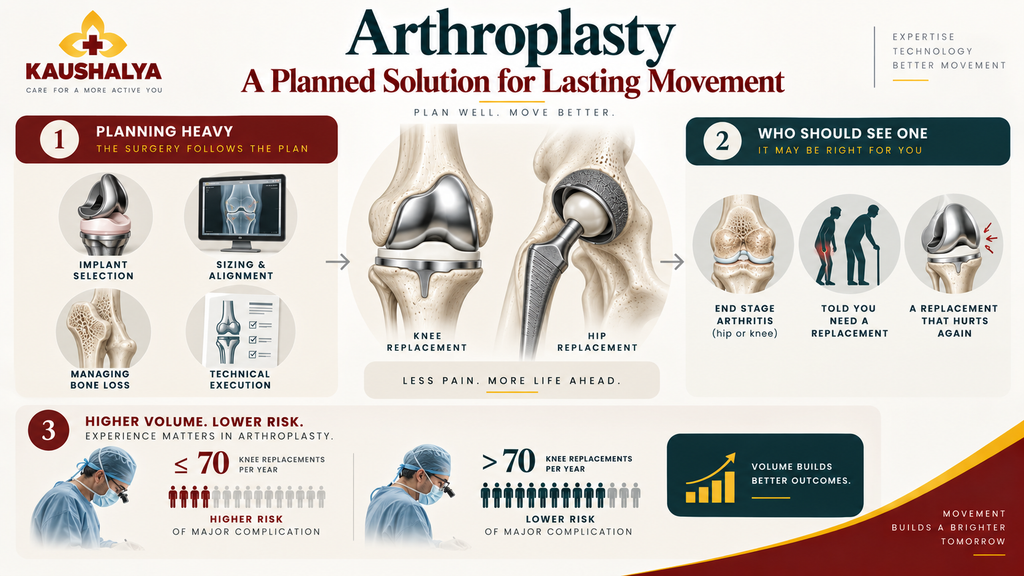
What it is really about
Replacement surgery is planning heavy. Implant selection, sizing, alignment and the management of bone loss are decided before theatre, off imaging, and the technical execution is the delivery of that plan.
Who should see one
Anybody with end stage arthritis of a hip or knee, anybody who has been told they need a replacement, and anybody with a replacement already in place that has started to hurt again.
Why volume shows up here more than anywhere
A propensity matched cohort study of surgeon procedure volume and complications after total knee arthroplasty found that cases performed by surgeons who had done 70 or fewer knee replacements in the preceding year carried an increased risk of a major surgical complication requiring further surgery.
Arthroscopy and sports
A different set of hands
Keyhole surgery through small portals with a camera, working in a fluid filled joint. It is a distinct skill and it does not transfer automatically from open surgery experience.
Who should see one
Sportspeople and active adults with ligament tears, meniscal injuries, recurrent shoulder dislocation, rotator cuff problems, or a knee that gives way.
The rehabilitation is half the specialty
Sports surgeons work inside a structured physiotherapy pathway with defined return to sport criteria. A surgeon without that pathway around them is doing the operation but not the treatment.
Trauma
The emergency half of orthopaedics
Fractures do not book appointments. Trauma practice is shaped by the emergency department, which is why it tends to sit with surgeons who are comfortable making decisions quickly with incomplete information.
Who should see one
Anyone with an acute fracture, a fracture that has not united, a previous fracture that has healed badly, or an older person with a hip fracture, which is a time critical injury rather than a routine one.
Where volume matters and where training matters less
An analysis of the American Board of Orthopaedic Surgery database on geriatric hip fracture found that annual case volume influenced surgeon reported complication rates while fellowship status by itself did not, which is a useful corrective to the assumption that the fellowship line is the thing to look for.
Spine
Often a separate department entirely
Spine surgery is performed by both orthopaedic surgeons and neurosurgeons, and in many hospitals the two work together. It has its own imaging, its own complication profile and its own decision thresholds.
Who should see one
Anyone with arm or leg pain caused by nerve compression, progressive weakness or numbness, neurogenic claudication, spinal deformity, or back pain that has failed a proper course of conservative treatment.
The high bar for operating
Most back pain is not surgical. A good spine surgeon says no frequently, and the frequency with which they say no is a reasonable proxy for judgement.
Hand, foot and ankle, and paediatrics
Hand
Dense anatomy in a small space. Tendons, nerves and small joints where a millimetre of malalignment is functionally significant. Carpal tunnel, tendon injuries, Dupuytren’s and small joint arthritis sit here.
Foot and ankle
Bunions, flat foot, ankle instability, Achilles problems and the foot complications of diabetes, which are managed in tandem with physicians and often with vascular input.
Paediatric orthopaedics
Children are not scaled down adults. Growth plates change how fractures are treated and how they heal, and some deformities correct themselves with growth while others must be treated early. This sub-specialty exists because getting that judgement wrong has decades of consequence.
Matching your problem to the right surgeon
| What is happening to you | Sub-specialty to ask for |
| Knee or hip arthritis, told you need a replacement | Arthroplasty |
| Knee gives way, twisting injury, suspected ligament tear | Arthroscopy and sports |
| Shoulder keeps dislocating, or cannot lift the arm overhead | Arthroscopy and sports, shoulder interest |
| Fresh fracture from a fall or accident | Trauma |
| Elderly parent with a fractured hip | Trauma, urgently |
| Leg pain with numbness or weakness, worse on walking | Spine |
| Pins and needles in the hand at night | Hand |
| Painful bunion or an ankle that keeps turning | Foot and ankle |
| Child with a limp, deformity or a fracture near a growth plate | Paediatric orthopaedics |
| Existing replacement that has become painful | Arthroplasty, revision experience specifically |
Reading the qualifications
| Letters | What they mean |
| MBBS | The basic medical degree, before any specialisation |
| MS (Ortho) | Master of Surgery in Orthopaedics, the standard three year postgraduate degree |
| DNB (Ortho) | Diplomate of National Board, awarded by the National Board of Examinations, held as equivalent to MS |
| D Ortho | Diploma in Orthopaedics, a shorter postgraduate diploma, often held alongside a degree |
| FCPS (Ortho) | Fellow of the College of Physicians and Surgeons, a Mumbai qualification |
| FICS | Fellow of the International College of Surgeons, an honorific rather than a training qualification |
| Fellowship | Post-degree sub-specialty training, the line that actually hints at sub-specialty, though it is not standardised in India |
Note what that table does not contain: any letter that reliably tells you the surgeon does fifty knee replacements a year. There is no such letter. You have to ask.
Does sub-specialty training change results
Sometimes clearly, sometimes not. A study on fellowship training and clinical outcomes following total knee arthroplasty reported lower rates of adverse events among arthroplasty trained surgeons compared with those trained in unrelated sub-specialties. Read alongside the hip fracture finding above, the sensible conclusion is that both training and volume matter, and that volume is easier for a patient to verify.
How to check, without any awkwardness
The three questions
- How many of my specific operation do you do in a year?
- Is this the part of orthopaedics you mainly work in?
- If my case turns out to be more complex than expected, who in the department would you involve?
Why the third one is the best of the three
It tells you whether there is a department behind the individual. A consultant who can name the colleague they would bring in is describing a working unit rather than a solo practice, and that is what you want when something unexpected happens.
What the department here looks like
The orthopaedic department at Kaushalya Medical Foundation Trust Hospital publishes four consultant surgeons with their areas of practice. Dr M V Sohoni, MS Ortho, D Ortho, FICS, with 37 years in practice, covering joint replacement, spine procedures, fracture management and arthritis. Dr Sandeep S Kelshikar, MS Ortho, D Ortho, with 30 years, in trauma and general orthopaedics. Dr Kiran Kumar Bhavnani, MS Ortho, DNB Orth, FCPS Ortho, D Ortho, with 25 years, in trauma, joint replacement and paediatric orthopaedics. Dr Sameep Sohoni, MS Ortho, DNB Ortho, FICS, with 11 years, in joint replacement, fracture surgery, arthritis and osteoporosis.
Wrapping up
The phrase orthopaedic doctor covers a joint replacement surgeon, a keyhole sports surgeon, a trauma surgeon on call at three in the morning, a spine surgeon who mostly advises against operating, and a paediatric specialist who works in millimetres on growing bone. They hold similar letters after their names and do largely different work. Choosing well is not about finding the best orthopaedic surgeon in Thane in the abstract. It is about matching your particular joint and your particular problem to somebody who deals with it regularly, then checking that there is a department behind them.
Kaushalya Medical Foundation Trust Hospital runs its orthopaedic surgery service with four consultants covering joint replacement, trauma, spine and paediatric orthopaedics, inside a 150 bed tertiary care hospital in Thane with five operation theatres, intensive care and 24 hour imaging on site.
If you are not sure which of them fits your problem, look through the consultant profiles and the hospital departments, or simply describe the problem when you call and ask to be pointed to the right clinic.
FAQs
What is the difference between an orthopaedic doctor and an orthopaedic surgeon in Thane?
In practice the terms are used interchangeably, since orthopaedics is a surgical specialty and its consultants operate. The distinction that actually matters to you is sub-specialty, meaning which part of orthopaedics that surgeon works in day to day.
Which orthopaedic specialist should I see for knee pain?
It depends on the cause. Arthritis in an older knee points to arthroplasty, a twisting injury with instability points to arthroscopy and sports, and a fracture points to trauma. Describing how the pain started usually routes you correctly.
Do I need a sub-specialist for a simple fracture?
Most straightforward fractures are managed very well by any competent orthopaedic surgeon. Sub-specialty matters more for complex fractures, fractures around joints or existing implants, fractures in children, and hip fractures in the elderly.
How can I tell how experienced a surgeon is with my operation?
Ask how many of that specific operation they perform in a year. Qualifications tell you about training level rather than current practice, and published research links annual case volume with complication rates.
Is a surgeon with more years of experience always better?
Not automatically. Years and volume are different things, and a surgeon with fifteen years focused on your particular procedure may well have performed more of them than one with thirty years spread across everything.
What if my problem needs more than one sub-specialty?
That is common, for example a diabetic foot problem or a spine issue with nerve involvement. It is precisely why a department with several consultants and other specialities in the same building is worth something, because the referral happens internally rather than sending you elsewhere.