

Summary: You need to see an orthopaedic doctor now if you have joint pain lasting more than two weeks, swelling that doesn’t settle, a knee that feels unstable or gives way, a popping or locking sensation, pain that wakes you at night, visible deformity after an injury, or limited range of motion. These signs, especially torn ligaments and knee ligament pain, point to problems that rarely resolve with rest alone and tend to worsen the longer they’re left unaddressed.
It’s easy to talk yourself out of seeing a doctor for joint pain. It doesn’t look serious; it’s not constant. Surely it’ll settle down. Sometimes it does. But certain signs are the body’s way of saying a joint problem has moved past the point where rest and painkillers are enough.
The 7 Signs That Need Attention Now
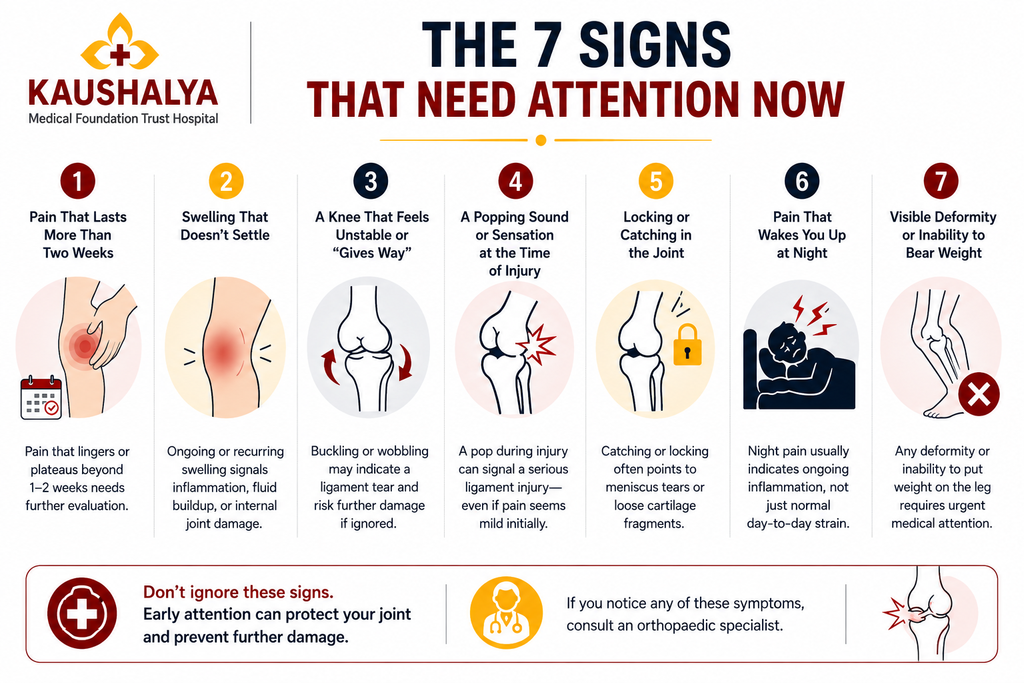
1. Pain That Lasts More Than Two Weeks
Minor strains and sprains typically improve noticeably within one to two weeks with rest and basic care. Pain that persists beyond that window, or that plateaus without improving, usually means something more than a simple soft tissue strain is going on.
2. Swelling That Doesn’t Settle
Swelling that appears after an injury and lingers for days, or swelling with no clear injury at all, often signals inflammation, fluid buildup, or internal joint damage. Swelling that comes back repeatedly after activity is a particularly clear sign that a joint is being aggravated by something structural.
3. A Knee That Feels Unstable or “Gives Way”
A knee buckling, wobbling, or feeling like it might give out during ordinary movement, walking, turning, or going down stairs is a classic symptom of knee ligament pain caused by torn ligaments. This instability happens because a torn ligament can no longer hold the joint securely through its normal range of motion.
Ligament tears causing this kind of instability are more common than most people assume. Population-based data puts the annual incidence of isolated ACL tears at roughly 69 per 100,000 person-years, and instability is typically the first symptom patients notice once the initial injury pain settles.
This sign in particular shouldn’t wait. Continuing on an unstable knee raises the risk of further internal damage with every awkward step.
4. A Popping Sound or Sensation at the Time of Injury
A distinct pop, felt or heard, at the moment of a twisting or impact injury is one of the more reliable indicators of a significant ligament injury, including a torn ACL or MCL. This is worth mentioning explicitly to a doctor even if the pain that follows feels manageable at first.
5. Locking or Catching in the Joint
A knee that catches, locks, or feels like it’s briefly stuck mid-movement often points to loose cartilage fragments or a meniscus tear interfering with normal joint mechanics. This sensation tends to worsen rather than resolve on its own.
6. Pain That Wakes You Up at Night
Pain severe enough to disturb sleep, particularly pain that isn’t clearly linked to how active you were during the day, usually reflects ongoing inflammation rather than simple overuse. Night pain is one of the clearer signals that a joint problem has progressed beyond the early stage.
7. Visible Deformity or Inability to Bear Weight
Any visible change in the shape of a joint after an injury, or a complete inability to put weight on a leg, needs urgent assessment rather than a wait-and-see approach. These signs can indicate a fracture, dislocation, or a severe ligament or tendon rupture.
Which Symptom, and What It Might Mean
| Symptom | Possible Underlying Issue |
| Pain beyond 2 weeks | Persistent strain, early arthritis, unresolved injury |
| Recurring swelling | Inflammation, internal joint damage |
| Knee gives way. | Torn ligament, joint instability |
| Popping at injury | ACL or MCL tear |
| Locking or catching | Meniscus tear, loose cartilage |
| Night pain | Advancing inflammation or arthritis |
| Deformity or can’t bear weight | Fracture, dislocation, severe rupture |
Why Delaying a Ligament Injury Assessment Is a Bigger Risk Than It Seems
Torn ligaments, particularly ACL tears, don’t heal on their own the way a simple sprain does, and the longer surgery or proper treatment is delayed, the more the rest of the knee tends to suffer. A meta-analysis found that delayed ACL surgery was associated with significantly higher rates of cartilage injury and meniscus tears compared with early surgical treatment, largely because ongoing instability in the joint causes cumulative damage the longer it’s left unaddressed.
In other words, waiting doesn’t just delay treatment; it often makes the eventual treatment more complicated than it needed to be.
What Happens at an Orthopaedic Assessment
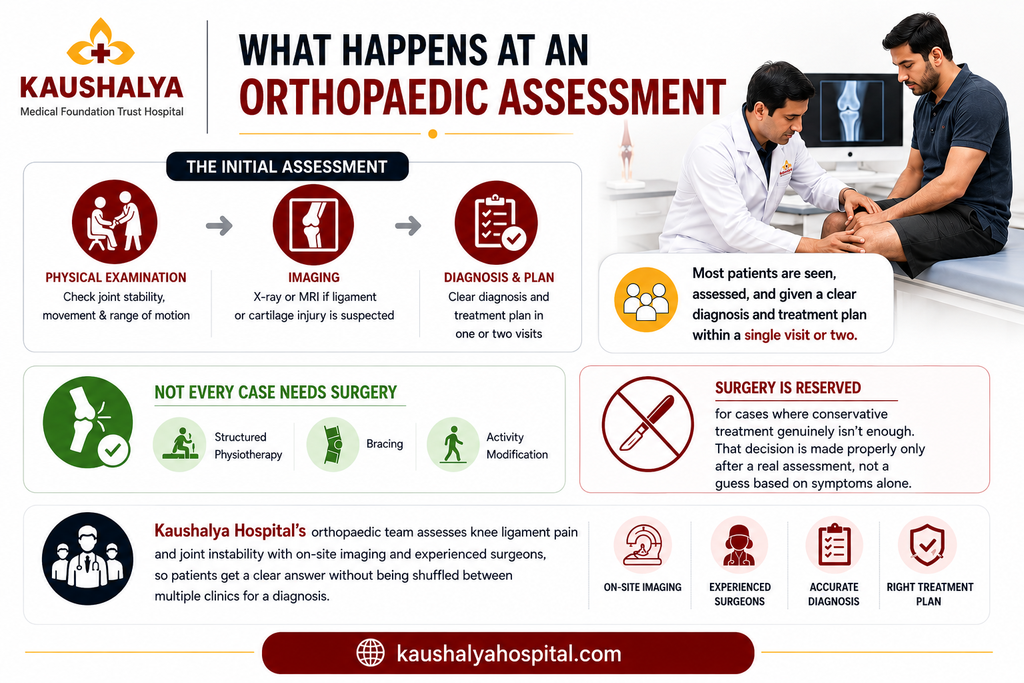
An initial orthopaedic assessment typically involves a physical examination of the joint’s stability and range of motion, followed by imaging such as an X-ray or MRI if a ligament or cartilage injury is suspected. Most patients are seen, assessed, and given a clear diagnosis and treatment plan within a single visit or two.
Not every case needs surgery. Many ligament and cartilage issues respond well to structured physiotherapy, bracing, and activity modification, and surgery is reserved for cases where conservative treatment genuinely isn’t enough. That decision is made properly only after a real assessment, not a guess based on symptoms alone.
Kaushalya Hospital’s orthopaedic team assesses knee ligament pain and joint instability with on-site imaging and experienced surgeons, so patients get a clear answer without being shuffled between multiple clinics for a diagnosis.
Frequently Asked Questions
Can a torn ligament heal without surgery?
Some ligament injuries, particularly partial tears, can improve with physiotherapy, bracing, and activity modification. Complete tears, especially of the ACL, often need surgical reconstruction if the knee remains unstable during normal activity.
How do I know if my knee pain is serious or just a minor strain?
Minor strains typically improve within one to two weeks. If pain persists beyond that, comes with swelling, instability, locking, or night pain, it’s worth a proper assessment rather than assuming it will resolve on its own.
Is it normal for a knee to feel unstable after an old injury?
No, ongoing instability, even from an injury that happened months or years ago, usually means the ligament never healed properly. This is worth assessing, since untreated instability increases the risk of further joint damage over time.
What is the difference between a sprain and a torn ligament?
A sprain is a partial stretch or minor tear of a ligament that usually heals with rest. A full ligament tear is a complete rupture that typically causes instability, swelling, and sometimes an audible pop, and it often needs a structured treatment plan rather than rest alone.
How urgently should I see a doctor if my knee locks or catches?
Fairly soon. Locking or catching usually indicates loose cartilage or a meniscus tear interfering with joint movement, and this rarely resolves without treatment. Delaying assessment risks further mechanical damage to the joint.
If any of these seven signs sound familiar, don’t wait for it to get worse. Book a consultation with Kaushalya Hospital’s orthopaedic team for a proper assessment.