

Summary: The most common mistakes before hip replacement surgery are skipping prehab exercises, delaying the decision too long, not preparing the home for recovery, ignoring weight and smoking advice, and going in with unrealistic expectations about recovery time. Most of these are avoidable with a few weeks of preparation. This guide covers the ten mistakes that most often slow down recovery after hip replacement surgery in Mumbai and beyond, and what to do instead.
Hip replacement is one of the most successful and well-understood surgeries in orthopaedics, but how a patient prepares beforehand has a real, measurable effect on how smoothly recovery goes. Most of the mistakes below aren’t dramatic, they’re small oversights that quietly make the first few weeks after surgery harder than they need to be.
The 10 Mistakes to Avoid
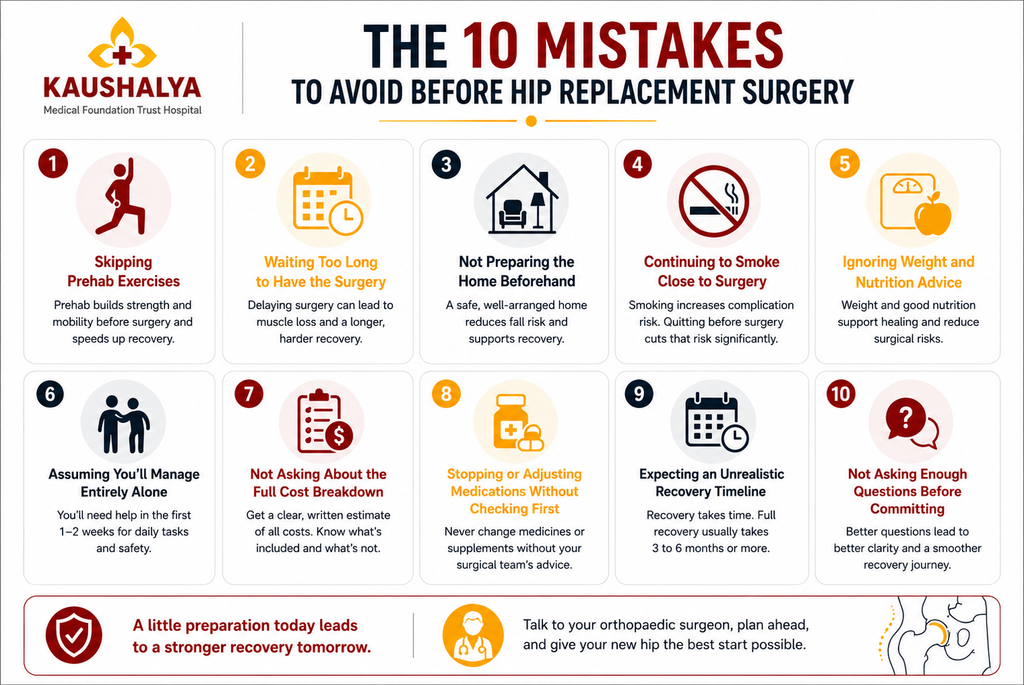
1. Skipping Prehab Exercises
Many patients assume physiotherapy only matters after surgery. In reality, the strength and mobility work done in the weeks before surgery, known as prehab, has a direct effect on how quickly you get moving afterward.
Structured pre-surgical exercise programmes have been shown to reduce the need for inpatient rehabilitation after joint replacement by up to 73% in some studies, largely because patients enter surgery stronger and more mobile than they otherwise would.
2. Waiting Too Long to Have the Surgery
Delaying hip replacement while managing pain with medication alone often means arriving at surgery weaker, stiffer, and more deconditioned than necessary. Muscles around a painful hip waste away the longer they’re avoided, and that lost strength has to be rebuilt from further behind afterward.
3. Not Preparing the Home Beforehand
Setting up your living space before surgery, removing trip hazards, arranging a raised toilet seat, clearing pathways, matters more than most patients expect. A cluttered or poorly arranged home significantly raises fall risk in the first few weeks after surgery, precisely when a fall is most dangerous to a new joint.
4. Continuing to Smoke Close to Surgery
Smoking meaningfully raises surgical risk. Active smokers face 1.5 to 3.2 times the risk of wound-related complications after joint replacement, and those who quit for four to six weeks before surgery and stay smoke-free afterward can cut their complication risk by roughly half.
If you smoke and have a surgery date, this is one of the highest-impact changes you can make in the time you have.
5. Ignoring Weight and Nutrition Advice
Carrying excess weight increases strain on the new joint and raises infection risk, since wound healing is harder to manage in patients with a higher BMI. Nutrition matters too, protein intake in particular supports tissue healing after surgery, and it’s worth discussing this with your surgical team rather than guessing.
6. Assuming You’ll Manage Entirely Alone
Recovery in the first one to two weeks typically requires help with basic tasks like cooking, driving, and getting in and out of bed safely. Patients who assume they’ll manage solo often end up straining the new hip earlier than they should, simply because no one is around to help with the things they physically can’t do yet.
7. Not Asking About the Full Cost Breakdown
Hospital charges, surgeon’s fees, implant cost, and rehabilitation are often quoted separately, and a headline number that doesn’t itemise these can be misleading. Ask for a written, line-by-line estimate before committing, and confirm what happens if your case turns out more complex than initially assessed.
8. Stopping or Adjusting Medications Without Checking First
Some medications, particularly blood thinners and certain supplements, need to be paused before surgery under medical guidance, while others must continue. Adjusting any of this on your own without confirming with your surgical team can lead to complications ranging from excess bleeding to inadequate pain control.
9. Expecting an Unrealistic Recovery Timeline
Most patients walk with support within a day of surgery, but full recovery typically takes three to six months, sometimes longer depending on age and fitness. Patients who expect to be back to normal within a couple of weeks often become discouraged mid-recovery, when in reality they’re progressing entirely normally.
10. Not Asking Enough Questions Before Committing
Patients who go into surgery with a clear understanding of the procedure, the implant, the expected timeline, and the risks tend to cope better with the recovery process, simply because there are fewer surprises. A rushed or vague consultation is a signal to ask more, not less.
Preparation Checklist by Category
| Category | Key Actions |
| Physical prehab | Strength and mobility exercises, weight management |
| Home setup | Remove trip hazards, arrange raised seating, clear pathways |
| Lifestyle | Quit smoking 4-6 weeks before; plan post-surgery help. |
| Medical | Confirm medication changes, get a full cost breakdown. |
| Expectations | Ask questions, understand a realistic recovery timeline. |
Why Preparation Matters as Much as the Surgery Itself
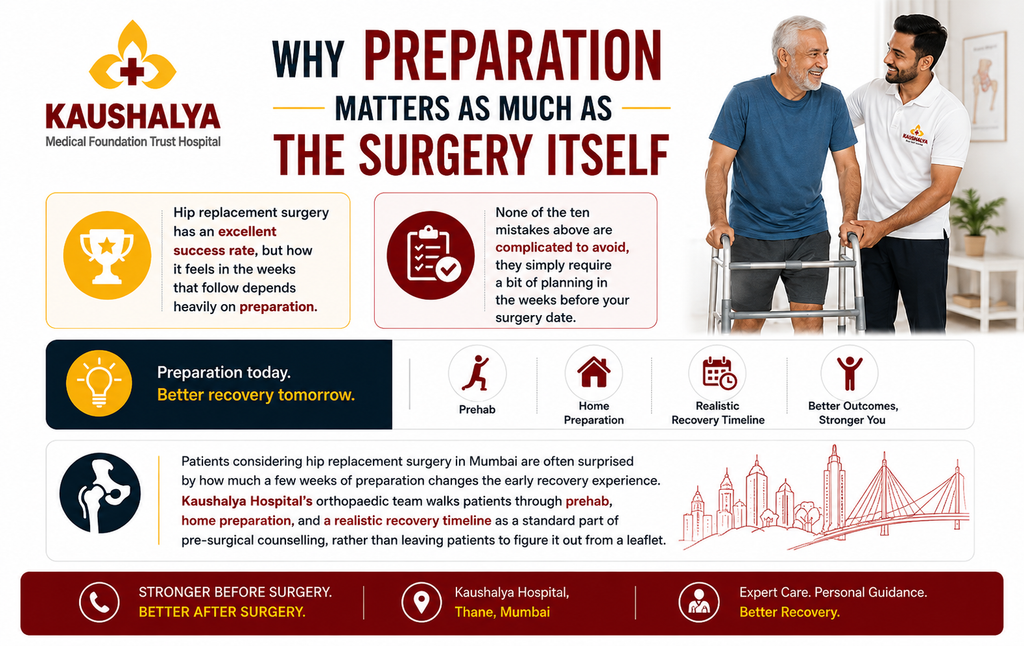
Hip replacement surgery has an excellent success rate, but how it feels for the patient in the weeks that follow depends heavily on preparation. None of the ten mistakes above are complicated to avoid, they simply require a bit of planning in the weeks before your surgery date rather than treating the operation as the only thing that matters.
Patients considering hip replacement surgery in Mumbai are often surprised by how much a few weeks of preparation changes the early recovery experience. Kaushalya Hospital’s orthopaedic team walks patients through prehab, home preparation, and a realistic recovery timeline as a standard part of pre-surgical counselling, rather than leaving patients to figure it out from a leaflet.
Frequently Asked Questions
How many weeks before surgery should I start prehab exercises?
Ideally six to eight weeks before your surgery date, giving your body enough time to build meaningful strength and mobility. Even two to three weeks of consistent exercise is better than none, so start as soon as a surgery date is confirmed.
Is it too late to quit smoking if my surgery is only a few weeks away?
No, it’s still worth doing. Even a few weeks of smoke-free time before surgery reduces complication risk compared with smoking right up to the operation, though four to six weeks gives a bigger benefit.
What’s the biggest mistake patients make right before hip replacement surgery?
Skipping prehab exercises is one of the most common and most avoidable mistakes. Patients who arrive at surgery physically stronger tend to need less inpatient rehabilitation and regain mobility faster afterward.
Do I really need help at home after hip replacement surgery?
Yes, for at least the first one to two weeks. Basic tasks like cooking, driving, and moving around the house safely are genuinely difficult in early recovery, and having support reduces fall risk and strain on the new joint.
Should I wait until the pain is unbearable before having hip replacement surgery?
No. Waiting too long often means going into surgery weaker and more deconditioned, which can make early recovery harder. A timely, well-planned surgery generally leads to a smoother recovery than one delayed to a crisis point.
Thinking about hip replacement and want a clear, honest assessment first? Book a consultation with Kaushalya Hospital’s orthopaedic team.