
By Kaushalya Medical Foundation Trust Hospital | Medically reviewed by a consultant orthopaedic surgeon
A bone density test cost in Mumbai and Thane usually sits somewhere around Rs 1,800 to Rs 3,500 for a standard DEXA scan of the spine and hip, with whole-body scans costing more. Women should generally have one from 65, and earlier after menopause if they have risk factors. Men and younger adults need one when there’s a clear reason, like a fragility fracture or long-term steroid use.
Key insights
- It’s a cheap test for an expensive problem: a DEXA scan costs less than a day’s hospital stay after a hip fracture.
- 65 is the default age for women: earlier if you’ve had early menopause, a low-impact fracture or long steroid courses.
- Indian numbers are worrying: in one large rural South Indian study, 39% of postmenopausal women had osteoporosis at the spine.
- A T-score is a comparison, not a verdict: it tells you how your bones compare with a healthy young adult’s.
Before you book
Ask for a DEXA scan of the lumbar spine and hip, the two sites that matter for diagnosis. A heel or finger scan at a health camp is a screening hint, not a diagnosis, and the numbers don’t translate. If you’re paying, pay for the right test.
Osteoporosis is quiet. There’s no pain, no warning sign and nothing to see in the mirror, right up until a minor fall breaks a wrist, a vertebra or a hip. For a lot of families in Thane and Mumbai, the first anyone hears about weak bones is in a casualty department.
That’s what a bone density test is for. It’s quick, painless and inexpensive, and it can show weak bone years before a fracture. The tricky part is knowing when it’s worth having and what to do with the result, so let’s cover the cost, the right age and the numbers in plain language.
How much does a bone density test cost in Mumbai and Thane?
A standard DEXA bone density scan of the spine and hip typically costs about Rs 1,800 to Rs 3,500 in the Mumbai region, depending on the centre and how many sites are scanned. Whole-body DEXA and body-composition scans cost more. Prices change, so check before you book.
| Test type | What it measures | Typical price range (Mumbai region) | Diagnostic? |
| DEXA, two sites (spine and hip) | Bone mineral density at the key fracture sites | About Rs 1,800 to Rs 3,500 | Yes, the standard test |
| DEXA, three sites (adds forearm) | Adds the wrist, useful in some cases | Higher than two-site | Yes |
| Whole-body DEXA | Bone, fat and muscle across the body | Usually Rs 3,500 and above | Not the usual diagnostic test |
| Heel ultrasound at a camp | Bone stiffness at the heel | Often free or low cost | No, screening only |
What changes the price
The number of sites scanned, whether a doctor’s report is included, and whether it’s part of a package. Hospital radiology departments and standalone diagnostic centres often charge differently for the same scan.
Is it covered by insurance?
Usually not as a standalone outpatient test, unless your policy covers OPD diagnostics or annual check-ups. It may be covered if it’s part of a hospital admission. Check your policy wording.
Who should have a bone density test, and at what age?
Women should have a bone density test from age 65, and postmenopausal women under 65 should be tested if they have risk factors. Men and younger adults should be tested when there’s a specific reason, such as a fracture from a minor fall or long-term steroid use.
The guideline behind “65”
The US Preventive Services Task Force’s 2025 update recommends screening women 65 and older for osteoporosis, and testing younger postmenopausal women whose risk assessment shows increased fracture risk. It found the evidence on routine screening of men insufficient to recommend it either way.
An age ladder
| Who | When to test |
| Women 65 and over | Routinely, even without symptoms |
| Postmenopausal women under 65 | If they have one or more risk factors (see below) |
| Men 70 and over | Discuss with your doctor, especially with risk factors |
| Anyone over 50 with a low-impact fracture | Yes, soon after the fracture |
| Anyone on long-term steroids | Yes, usually at the start of long-term treatment |
| Younger adults with conditions affecting bone | When advised by their specialist |
Risk factors that bring testing forward
- Early menopause, before 45
- A previous fracture from a minor fall
- A parent who broke a hip
- Long-term steroid tablets
- Low body weight
- Smoking or heavy drinking
- Rheumatoid arthritis, thyroid or parathyroid disease, or conditions affecting absorption
Why is osteoporosis a bigger worry in India than people think?
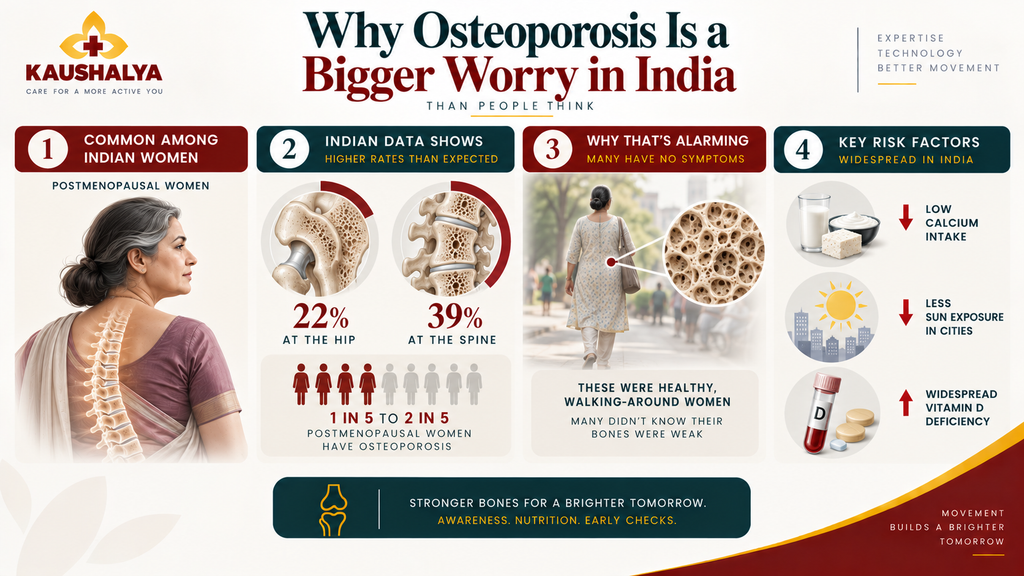
Osteoporosis appears common among Indian women after menopause, often alongside low calcium intake and vitamin D deficiency. Large Indian studies have found osteoporosis in roughly a fifth to two-fifths of postmenopausal women, depending on the site measured.
What the Indian data shows
A study of 1,565 rural South Indian postmenopausal women found osteoporosis in 22% at the hip and 39% at the spine. More than half had vitamin D deficiency, and average daily calcium intake was well below recommended levels.
Why that’s alarming
These weren’t hospital patients. They were healthy, walking-around women in the community. Many of them would have had no idea their bones were weak.
Calcium and vitamin D
Diet is a big part of the story. Dairy intake varies, sun exposure is lower than people assume in cities, and vitamin D deficiency is widespread. A bone density result often comes with a blood test for vitamin D and calcium alongside.
How do you read a bone density report?
A bone density report gives a T-score, which compares your bone density with a healthy young adult’s. A T-score of minus 1 or higher is normal, between minus 1 and minus 2.5 is osteopenia, and minus 2.5 or lower is osteoporosis.
| T-score | Category | What it usually means |
| Minus 1.0 or higher | Normal | Healthy bone density |
| Between minus 1.0 and minus 2.5 | Osteopenia | Lower than ideal, raised fracture risk |
| Minus 2.5 or lower | Osteoporosis | Significantly weakened bone |
| Minus 2.5 or lower plus a fragility fracture | Severe osteoporosis | High fracture risk, treatment usually advised |
T-score vs Z-score
The Z-score compares you with people of your own age and sex. It’s more useful for children, premenopausal women and younger men, where a T-score can mislead.
The number isn’t the whole decision
Doctors combine the T-score with age, past fractures and other risks to estimate your actual fracture risk. Two people with the same T-score can need different treatment.
What happens if your bone density is low?
Low bone density is usually managed with calcium and vitamin D, strength and balance exercise, fall prevention at home and, where fracture risk is high, medication that slows bone loss or builds bone. Most people are re-scanned after a year or two to check progress.
Lifestyle first
Weight-bearing exercise like brisk walking, strength work, enough protein and calcium, stopping smoking and cutting back on alcohol all help.
Medication
Bisphosphonates are the most common first-line drugs. Other options exist for people at very high risk or who can’t take them. Your doctor will weigh the benefits against side effects.
Fall-proofing at home
Good lighting, no loose rugs, grab bars in the bathroom and the right footwear. Most hip fractures in older adults start with a simple fall at home.
Why does bone density matter if you might need a hip operation?
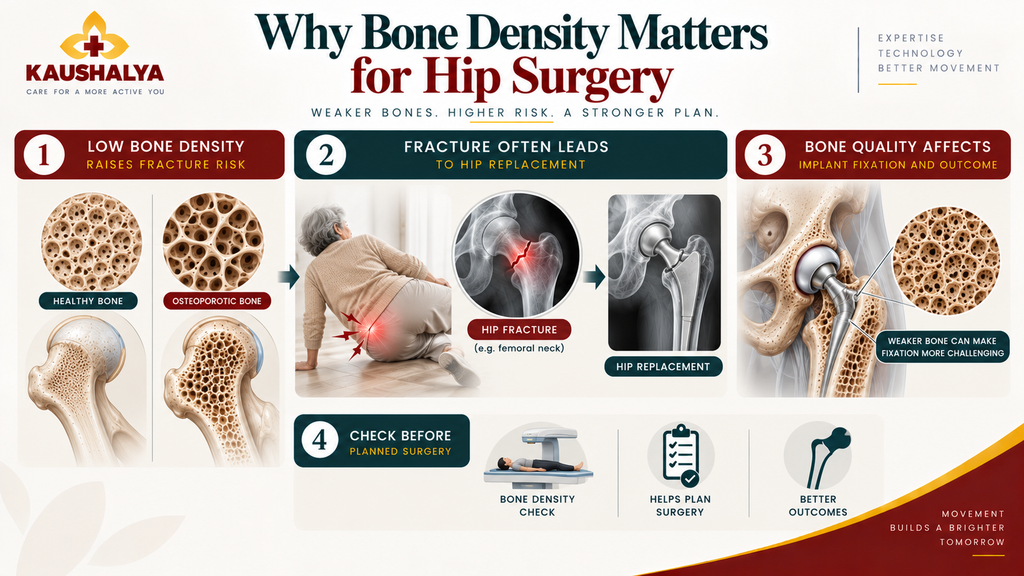
Weak bones raise the risk of hip fractures, and a hip fracture in an older adult often ends in hip replacement surgery, in Mumbai and everywhere else. Bone quality also matters for how implants are fixed in place. So bone health and hip surgery are closely linked.
Fracture to surgery
Many older patients who need hip replacement surgery in Mumbai and Thane don’t arrive with arthritis. They arrive after a fall, with a broken femoral neck. A scan years earlier could have flagged the risk.
Before planned joint surgery
If you’re already planning a hip or knee replacement and you have osteoporosis risk factors, ask your surgeon whether a bone density check makes sense. It can affect the surgical plan and what happens after.
Wrapping up
A bone density test is one of the cheapest, easiest ways to spot a problem that otherwise announces itself with a broken hip. Expect to pay roughly Rs 1,800 to Rs 3,500 for a standard spine and hip DEXA scan in the Mumbai region. Women should have one from 65, earlier with risk factors, and anyone over 50 who breaks a bone in a minor fall should get checked.
At Kaushalya Medical Foundation Trust Hospital in Thane West, the orthopaedic and radiology teams can help you decide whether you need a scan, interpret your result and plan what comes next, including bone health care and fracture prevention. Ask about bone density testing alongside our health check-up packages, or speak to an orthopaedic specialist if you’ve already had a fracture.
FAQs
How much does a DEXA scan cost in Mumbai?
A standard two-site DEXA scan of the spine and hip usually costs around Rs 1,800 to Rs 3,500 in the Mumbai region. Whole-body scans cost more. Prices vary by centre, so check what’s included before booking.
At what age should women get a bone density test?
Women should be tested from 65. Postmenopausal women under 65 should be tested earlier if they have risk factors such as early menopause, a previous fragility fracture, long-term steroid use or low body weight.
Should men get a bone density test?
Not routinely, but men should be tested if they have a fracture from a minor fall, take long-term steroids or have conditions that weaken bone. Men over 70 should discuss testing with their doctor.
Is a DEXA scan safe?
Yes. A DEXA scan uses a very low dose of X-rays, much lower than a standard chest X-ray. It’s painless, takes around 10 to 20 minutes and you can go about your day immediately afterwards.
What T-score means osteoporosis?
A T-score of minus 2.5 or lower means osteoporosis. Between minus 1 and minus 2.5 is osteopenia, and minus 1 or higher is normal. Doctors combine this with age and fracture history to judge risk.
How often should you repeat a bone density test?
If your result is low or you’ve started treatment, a repeat scan is usually done after one to two years. If your result was normal and you have no new risk factors, repeat testing is less frequent.