

Medically reviewed by a consultant orthopaedic and joint replacement surgeon.
Summary: Most people walk with support the same or next day after hip replacement, return to light daily activities within 2 to 6 weeks, and feel largely back to normal by 3 months, with full recovery taking up to a year. Recovery speed depends on your fitness, the surgery, and the rehabilitation you do. Choosing an experienced orthopaedic doctor in Thane makes a real difference to how smoothly it goes. Here is the realistic timeline.
Recovery is usually the first question people ask, and understandably so. A hip replacement is a big decision, and most of the worry is not about the operation itself but about the weeks that follow.
The reassuring reality is that hip replacement is one of the most successful operations in modern medicine, and recovery follows a fairly predictable path. Knowing that path in advance takes a lot of the anxiety out of it.
How long does it take to recover from hip replacement surgery?
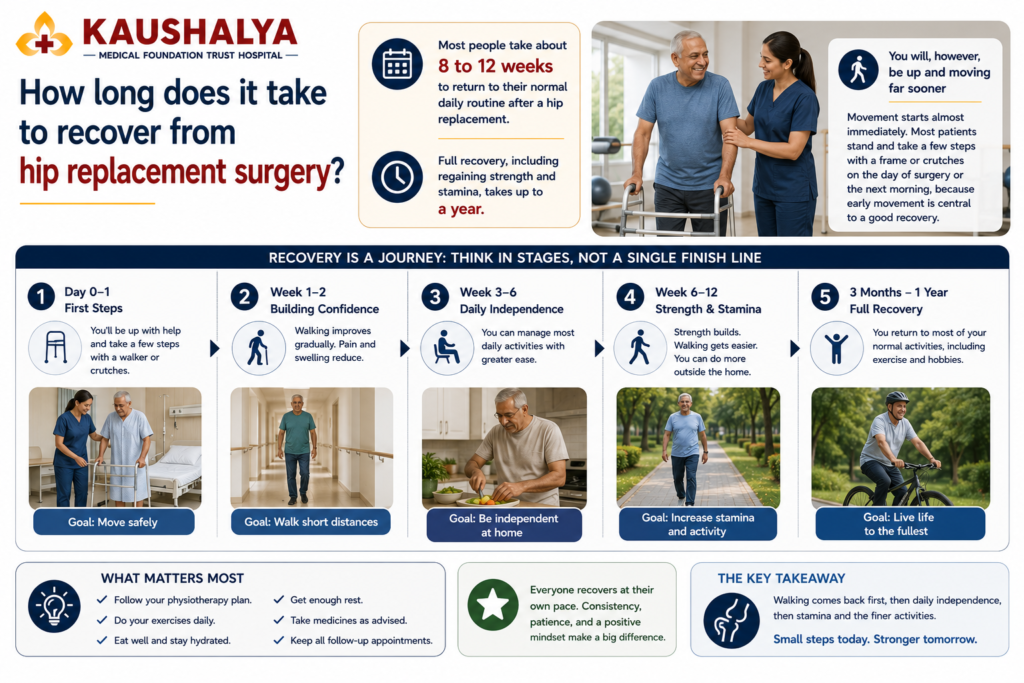
Most people take about 8 to 12 weeks to return to their normal daily routine after a hip replacement, with full recovery, including regaining strength and stamina, taking up to a year. You will, however, be up and moving far sooner than that.
Movement starts almost immediately. Most patients stand and take a few steps with a frame or crutches on the day of surgery or the next morning, because early movement is central to a good recovery.
The key is to think in stages rather than expecting a single finish line. Walking comes back first, then daily independence, then stamina and the finer activities.
What does week-by-week recovery look like?
Recovery moves in clear phases, from cautious first steps to a near-normal routine by around three months. The table below shows a typical progression, though your surgeon’s guidance always comes first.
| Stage | What to expect |
| Days 1 to 7 | Walking with a frame or crutches, wound care, gentle prescribed exercises |
| Weeks 2 to 6 | Increasing walking distance, reducing reliance on aids, light daily tasks |
| Weeks 6 to 12 | Returning to most normal activities, better strength, longer walks |
| 3 to 12 months | Building stamina, resuming leisure activities, full recovery of strength |
Progress is not always perfectly linear. Some days feel better than others, and that is normal. What matters is the overall trend, which should be steadily upward.
When can you walk, drive, and return to work?
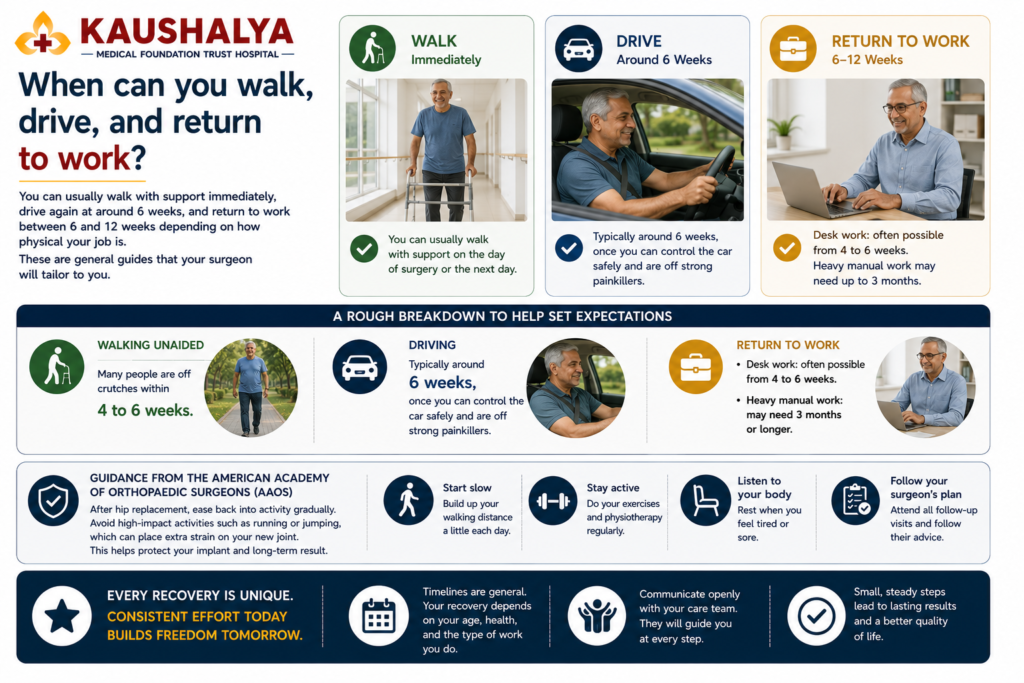
You can usually walk with support immediately, drive again at around 6 weeks, and return to work between 6 and 12 weeks depending on how physical your job is. These are general guides that your surgeon will tailor to you.
A rough breakdown helps set expectations:
- Walking unaided: many people are off crutches within 4 to 6 weeks.
- Driving: typically around 6 weeks, once you can control the car safely and are off strong painkillers.
- Desk work: often possible from 4 to 6 weeks; heavy manual work may need 3 months.
Guidance from the American Academy of Orthopaedic Surgeons on activities after hip replacement stresses easing back into activity gradually and avoiding high-impact strain on the new joint, which protects your result.
What helps you recover faster?
The biggest factors in a fast recovery are being reasonably fit before surgery, following your physiotherapy programme, and sticking to the movement precautions your team gives you. Recovery is something you actively do, not something that just happens to you.
The habits that consistently help:
- Prehabilitation: building strength and mobility before surgery.
- Physiotherapy: doing your prescribed exercises daily, not occasionally.
- Healthy weight: less load on the new joint speeds progress.
- Following precautions: respecting early limits on bending and twisting protects the hip while it heals.
Patients who go in stronger and stay consistent with rehabilitation almost always recover more quickly and comfortably than those who wait until they are deconditioned.
How long will a hip replacement last, and why does the surgeon matter?
A modern hip replacement is built to last decades, and recent long-term data shows that more than 90% of hip replacements are still working well at up to 30 years. That durability, combined with a smooth recovery, is why the operation is so well regarded.
But results are not automatic. The precision of the surgery, the choice of implant, and the rehabilitation plan all influence both how fast you recover and how long the joint lasts. This is where the experience of your surgeon counts.
Choosing the best orthopaedic surgeon in Thane you can access at Kaushalya Hospital, one who does joint replacements regularly and supports you through rehabilitation, is one of the most important decisions in the whole process. A well-done replacement recovers faster and lasts longer.
Frequently asked questions
How soon can I walk after a hip replacement?
Usually the same day or the day after surgery, with a frame or crutches. Early walking is encouraged because it improves circulation, reduces stiffness, and speeds recovery. You gradually increase distance and reduce reliance on walking aids over the following weeks.
Is hip replacement recovery painful?
There is discomfort in the first couple of weeks, managed with prescribed pain relief, but most people find it more manageable than the arthritis pain they had before. Pain steadily decreases, and by around 12 weeks it is usually minimal for most patients.
How long will I be off work?
It depends on your job. Desk-based workers often return in 4 to 6 weeks, while those doing heavy manual work may need around 3 months. Your surgeon will advise based on your recovery and how physically demanding your role is.
Can I climb stairs after a hip replacement?
Yes, usually within the first days, using a technique your physiotherapist teaches you. You lead with the non-operated leg going up and the operated leg going down at first. Stair confidence improves quickly as strength returns.
What can go wrong if I overdo it too early?
Doing too much too soon can cause pain, swelling, and, rarely, dislocation of the new joint before it has stabilised. Following your team’s movement precautions in the early weeks protects the hip while healing, then you progressively build activity as advised.
Trusted joint replacement care in Thane
Because recovery depends so much on how the surgery is done and supported, the team behind it is central to the result. Kaushalya Hospital brings together experienced joint replacement surgeons, modern theatres, in-house physiotherapy, and full critical-care backup, so your whole recovery pathway is coordinated in one place.
The approach pairs careful surgical planning with a structured rehabilitation programme and clear guidance at every stage, so you always know what to expect next. Patients are supported from the pre-operative assessment through to getting fully back on their feet.
A hip replacement can give you back the movement and sleep that arthritis took away, and recovery is very manageable when it is done well and properly supported. If hip arthritis is limiting your life, get expert advice on the operation and what your personal recovery would look like. Schedule an appointment with the orthopaedic team today.