
By Kaushalya Medical Foundation Trust Hospital | Medically reviewed by a consultant orthopaedic surgeon
A bipolar hemiarthroplasty is a partial hip replacement that swaps out only the broken ball of the thigh bone and leaves your own hip socket in place. The “bipolar” part means the new ball has two bearing surfaces, an inner one and an outer one, so movement is shared between them. Surgeons usually choose it over a total hip replacement for older or frailer patients with a displaced hip fracture, because it’s a shorter operation with a lower dislocation risk.
Key insights
- It’s mostly a fracture operation: hemiarthroplasty is chosen for broken hips, not for arthritis.
- Your socket stays: only the femoral side is replaced, which keeps the operation shorter.
- In a large trial, reoperation rates were similar: about 8% after both hemiarthroplasty and total hip replacement over two years.
- Total hip still suits some patients: fitter, independently mobile people may do slightly better with it.
Before you agree to surgery
Ask the surgeon three things: why they’re recommending partial rather than total, whether the implant is cemented, and when your parent will be helped out of bed. Clear answers to those three tell you the plan has been thought through for this patient, not just for “a hip fracture”.
The call usually comes at an awful time. An elderly parent has slipped in the bathroom, they can’t stand, and an X-ray shows a broken hip. Within hours, an orthopaedic doctor in Thane is talking about “bipolar hemiarthroplasty” and asking you to sign a consent form.
It’s a lot to take in, and families often worry they’re being steered to a lesser operation. They usually aren’t. Hemiarthroplasty is one of the most common, well-studied operations in orthopaedics, and for the right patient it’s the better choice. Here’s what it is, how it differs from a full hip replacement and how surgeons decide.
What is bipolar hemiarthroplasty?
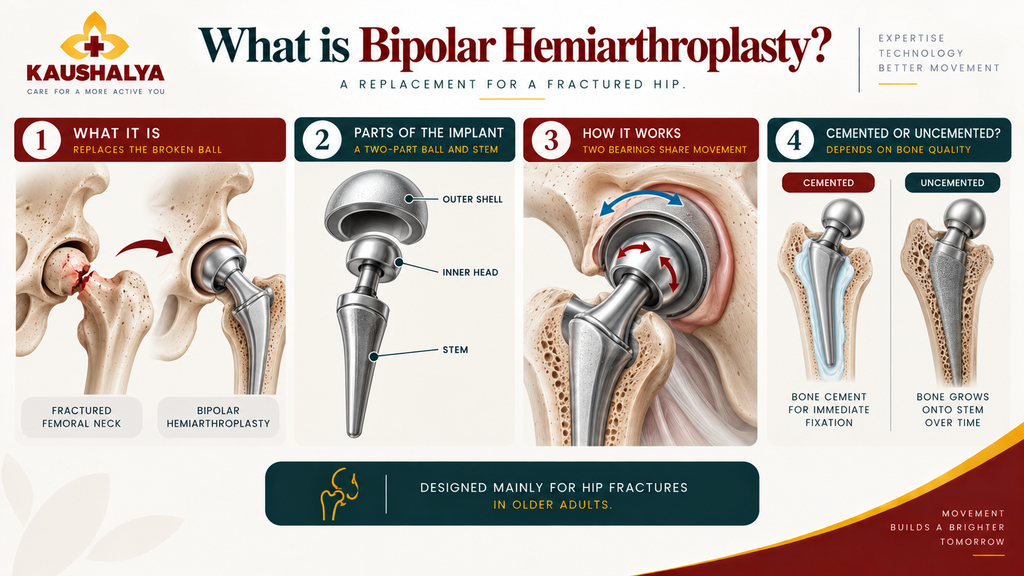
Bipolar hemiarthroplasty is surgery that removes the broken head of the femur, the “ball” of the hip, and replaces it with a metal stem and a two-part ball. The patient’s natural socket is left untouched. It’s used mainly for displaced fractures of the femoral neck in older adults.
The parts of the implant
There’s a stem that sits inside the thigh bone, a small inner head on top of the stem, and a larger outer shell that sits in your own socket. The inner head moves inside the shell, and the shell moves in the socket.
Why two bearings?
The idea is that sharing movement between two surfaces reduces wear on the patient’s own cartilage in the socket. Whether that makes a big clinical difference over a unipolar implant is still debated, but bipolar designs are widely used.
Cemented or uncemented?
The stem can be fixed with bone cement or pressed in so bone grows onto it. In older patients with osteoporotic bone, cemented stems are commonly preferred because they give immediate, reliable fixation.
How is it different from a total hip replacement?
A total hip replacement replaces both the ball and the socket, while a hemiarthroplasty replaces only the ball. Total hip replacement is the standard operation for arthritis. Hemiarthroplasty is mainly used for hip fractures, where the socket is usually healthy.
| Feature | Bipolar hemiarthroplasty | Total hip replacement |
| What’s replaced | Ball of the femur only | Ball and socket |
| Main use | Displaced femoral neck fracture | Arthritis, and some fractures in fit patients |
| Operating time | Shorter | Longer |
| Dislocation risk | Lower | Higher, in fracture patients |
| Long-term socket wear | Possible, as own cartilage carries load | Not an issue, socket is lined |
| Typical patient | Older, frailer, lower activity | Fitter, independent, more active |
Unipolar vs bipolar
A unipolar implant has a single solid head. A bipolar implant has the inner and outer bearings. Both are partial hip replacements, and the choice depends on the surgeon’s judgement and the patient.
When does a surgeon choose hemiarthroplasty over a full hip replacement?
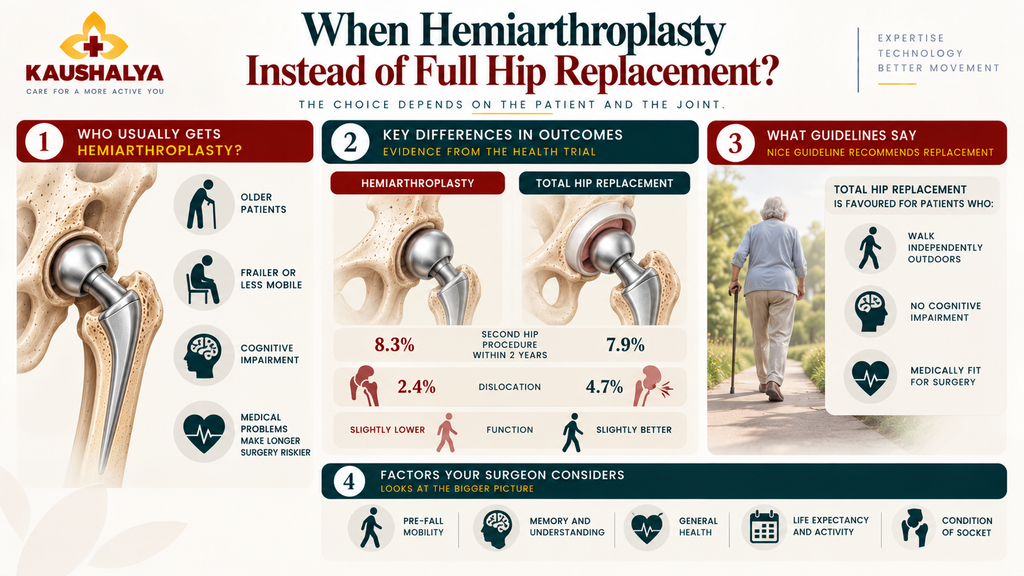
Surgeons usually choose hemiarthroplasty for older patients with a displaced femoral neck fracture who are frailer, have limited mobility or cognitive impairment, or have medical problems that make a longer operation riskier. Total hip replacement is favoured for fitter, independently mobile patients.
What the evidence says
The HEALTH trial randomised 1,495 patients aged 50 or older with displaced femoral neck fractures to either operation. A second hip procedure within two years was needed in 7.9% after total hip replacement and 8.3% after hemiarthroplasty, a difference that wasn’t significant. Dislocation was more common after total hip replacement, at 4.7% against 2.4%, while function slightly favoured total hip.
What the guideline says
The UK’s NICE hip fracture guideline advises replacement arthroplasty for displaced intracapsular fractures, and recommends total hip replacement for patients who could walk independently outdoors with no more than a stick, aren’t cognitively impaired and are medically fit for it.
The factors your surgeon weighs
- Mobility before the fall: walking unaided outdoors points towards total hip.
- Memory and understanding: patients who can’t follow hip precautions are at higher dislocation risk.
- General health: heart, lung and kidney problems favour the shorter operation.
- Life expectancy and activity: very active, long-living patients may outgrow a hemiarthroplasty.
- The socket itself: if there’s arthritis in the socket, a total hip makes more sense.
Why not just fix the broken bone with screws?
In older patients, a displaced femoral neck fracture often cuts the blood supply to the ball, so screws frequently fail and the ball can collapse. Replacing the ball avoids that and lets the patient bear weight straight away. Screws are more often used for undisplaced fractures or in younger patients.
Blood supply is the issue
The femoral head gets much of its blood through vessels that run along the neck. When the neck breaks and shifts, those vessels can tear, and the head may not heal or may die.
Getting up quickly matters
An elderly patient lying in bed for weeks risks pneumonia, clots, bedsores and muscle wasting. A replacement that takes weight immediately is often the safer option overall.
What does recovery after hemiarthroplasty look like?
Most patients are helped to stand and take a few steps within a day or two of surgery, walk with a walker in the first weeks and progress to a stick over the following weeks. Full recovery depends heavily on how mobile the person was before the fracture.
| Time after surgery | What usually happens |
| Day 1 to 2 | Sitting up, standing, first steps with support |
| Days 3 to 7 | Walking short distances with a walker, discharge planning |
| Weeks 2 to 6 | Building walking distance, home physio, stitches or clips out |
| Weeks 6 to 12 | Moving to a stick, regaining confidence and balance |
Setting up the bed at home
Bed height matters more than people think. A bed that’s too low makes getting up hard and risky. A firm, supportive mattress helps, and families often ask about an orthopaedic mattress. If you’re choosing one, our guide to orthopaedic mattresses in India covers what firmness to look for. The key is that the patient doesn’t sink too deep to get up easily.
Precautions
Your surgeon will tell you which movements to avoid, often deep bending or crossing the legs in the early weeks, depending on the surgical approach. Raised toilet seats and a chair with arms make a real difference.
Fall-proofing
The same home that caused the first fall can cause the second. Night lights, no loose rugs, bathroom grab bars and non-slip footwear are worth sorting before discharge.
What are the risks of hemiarthroplasty?
The main risks include infection, dislocation, blood clots, fracture around the implant, leg-length difference and, over time, wear of the patient’s own socket cartilage. Older patients also face general risks from anaesthesia and immobility, which is why getting them moving quickly is such a priority.
Socket wear
Because the patient’s own cartilage takes the load, some people develop groin pain years later as it wears. A small number need conversion to a total hip replacement.
Delirium
Confusion after surgery is common in elderly patients. Familiar faces, glasses and hearing aids, a regular day-night routine and good pain control all help.
Wrapping up
Bipolar hemiarthroplasty isn’t a second-best hip replacement. It’s a different operation for a different situation: a broken hip in a patient for whom a shorter, more stable operation makes the most sense. Large trials show similar reoperation rates to total hip replacement, with less dislocation and slightly less function. The right choice depends on how your parents were living before the fall.
At Kaushalya Medical Foundation Trust Hospital, a 150-bed trust hospital in Thane West, the orthopaedic surgery team performs hemiarthroplasty, total hip replacement and fracture fixation, with intensive care on site for older patients who need closer monitoring. If someone in your family has had a hip fracture, or you’d like a second opinion on the type of operation advised, speak to an orthopaedic doctor in Thane on our team today.
FAQs
What is bipolar hemiarthroplasty?
It’s a partial hip replacement where only the broken ball of the femur is replaced with an implant that has two bearing surfaces. The patient’s own hip socket is kept. It’s mainly used for displaced femoral neck fractures.
Is hemiarthroplasty better than total hip replacement?
Neither is better for everyone. In a large trial, reoperation rates were similar. Hemiarthroplasty had fewer dislocations, while total hip replacement gave slightly better function. Fitter, independent patients often suit total hip replacement.
How long does a hemiarthroplasty last?
Many hemiarthroplasties last for the rest of the patient’s life, especially in older patients. Some people develop socket wear over time and need conversion to a total hip replacement, which is more likely in younger, active patients.
How soon can you walk after hemiarthroplasty?
Most patients stand and take a few steps with support within a day or two of surgery. They usually walk with a walker for the first weeks and move to a stick over the following weeks.
What is the difference between unipolar and bipolar hemiarthroplasty?
A unipolar implant has a single solid head moving in the socket. A bipolar implant has an inner head inside an outer shell, so movement is shared between two surfaces. Both replace only the ball.
What mattress is best after hip surgery?
A firm, supportive mattress on a bed at a comfortable height is best, so the patient doesn’t sink and can get up easily. Avoid very soft or very low beds in the first few months.