
By Kaushalya Medical Foundation Trust Hospital | Medically reviewed by a consultant orthopaedic surgeon
Frozen shoulder treatment works best when it matches the stage you’re in. In the painful early stages, the priority is pain control, often with a steroid injection, and gentle movement. In the stiff middle stage, stretching and physiotherapy do more. If the shoulder stays locked after months of proper treatment, a procedure to release the capsule is the next step. Using the right tool at the wrong stage is why so many people feel nothing is working.
Key insights
- Stage decides treatment: an injection that’s very useful at month two does far less at month ten.
- “It’ll go away on its own” isn’t reliable: a systematic review found no evidence that frozen shoulder always fully resolves without treatment.
- Aggressive stretching early makes it worse: pushing a painful, inflamed shoulder usually backfires.
- Diabetes changes the picture: it raises the risk and tends to make recovery slower.
Before you’re told to “just wait”
Waiting is sometimes reasonable, but it should be an active plan, not a shrug. Ask which stage your shoulder is in, what you’re aiming to change in the next six weeks, and what happens if it doesn’t change. If nobody can answer those three, get a second opinion.
Frozen shoulder is one of those conditions that sounds mild and isn’t. It usually starts as a vague ache you sleep on wrongly. A few weeks later you can’t reach your back pocket, fasten a bra, or comb the back of your hair. And the night pain can be brutal.
What makes it maddening is the advice. One person says get an injection, another says physio, another says it’ll sort itself out in a year or two. All three can be right, because frozen shoulder changes over time, and so does what works. Let’s go through it stage by stage.
What is frozen shoulder, and why does it happen?
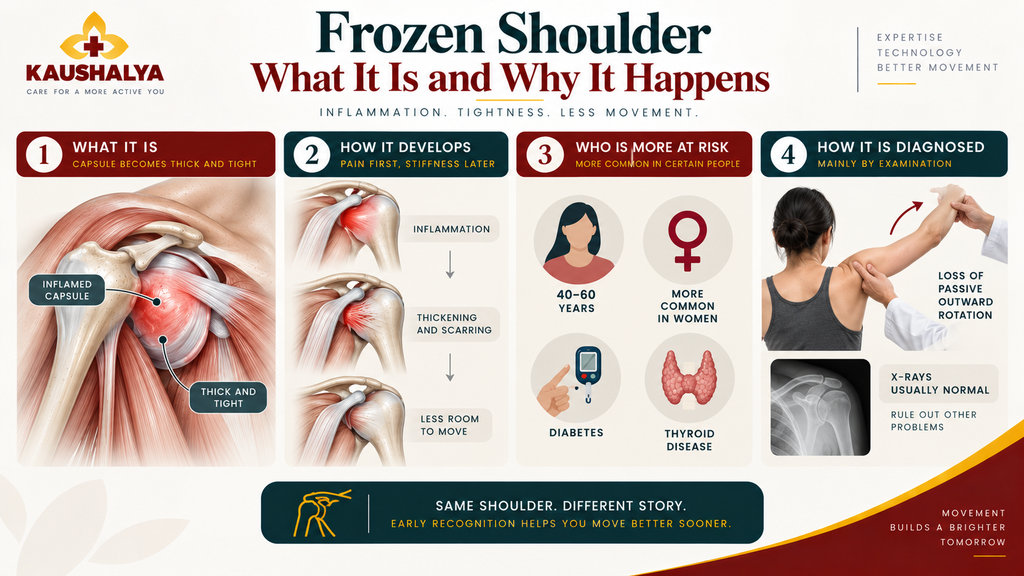
Frozen shoulder, or adhesive capsulitis, is inflammation and thickening of the capsule around the shoulder joint, which then tightens and scars. It causes pain first and stiffness later. It’s more common between 40 and 60, more common in women, and much more common in people with diabetes or thyroid disease.
What’s going on inside
The capsule is the soft envelope that holds the ball of the shoulder in its socket. In frozen shoulder it becomes inflamed, then thick and tight, so the ball simply has less room to move. That’s why it’s stiff in every direction, not just one.
Primary and secondary
Sometimes there’s no clear cause. Other times it follows an injury, surgery or a long period of keeping the arm still. Diabetes, thyroid disease and some autoimmune conditions are recognised risk factors.
How it’s diagnosed
Mostly by examination. The classic sign is loss of passive outward rotation: even when the doctor moves your arm for you, it won’t turn out. X-rays are usually normal but help rule out arthritis, calcium deposits or an old dislocation.
What are the four stages of frozen shoulder?
Frozen shoulder is usually described in four stages: a painful early stage with little stiffness, a freezing stage where pain and stiffness both build, a frozen stage where stiffness dominates, and a thawing stage where movement slowly returns. The timings below are typical, not fixed.
| Stage | Typical timing from onset | Main problem | What it feels like |
| 1. Painful, early | 0 to 3 months | Pain, especially at night | Hurts at the end of movement, still mostly moves |
| 2. Freezing | About 3 to 9 months | Pain and growing stiffness | Can’t reach behind your back, sleep disturbed |
| 3. Frozen | About 9 to 15 months | Stiffness | Pain eases, but the arm won’t go further |
| 4. Thawing | About 15 to 24 months | Slow return of movement | Gradual improvement, often incomplete |
Does it always resolve on its own?
Not reliably. A 2017 systematic review tested the old idea that frozen shoulder goes through these phases and fully recovers without treatment, and found no evidence supporting full resolution without treatment. Untreated patients improved somewhat over one to four years, but not completely, and most improvement happened early rather than late.
Why that matters
If you’re told to wait two years, you’re being asked to accept a long, uncertain recovery that may leave you short of full movement. Treatment can make the journey shorter and more comfortable.
What works in stage 1, the painful early stage?
In the early painful stage, the most useful treatments are pain control and an intra-articular steroid injection, alongside gentle movement that stays within comfort. The aim is to calm the inflammation before the capsule stiffens. Hard stretching at this point usually makes things worse.
Steroid injection
A steroid injection into the shoulder joint is most effective early, when inflammation is driving the pain. It doesn’t “unfreeze” a shoulder, but it can cut the pain enough for you to sleep and move.
Painkillers
Simple painkillers and, where suitable, anti-inflammatories help with night pain. Your doctor will check what’s safe for you, especially if you have diabetes, kidney problems or stomach issues.
Movement, but gently
Pendulum swings and gentle range-of-motion exercises keep the joint from seizing up. If an exercise leaves you sore for hours, it’s too much for this stage.
What to avoid
Forceful stretching, heavy gym work and “pushing through” pain. They irritate an already inflamed capsule.
What works in stage 2, the freezing stage?
In the freezing stage, pain control still comes first, but structured physiotherapy and, in selected patients, hydrodilatation start to play a bigger role. The aim is to limit how much movement you lose while the capsule is actively tightening.
Physiotherapy
Supervised physio keeps you moving and teaches safe stretches you can do at home. The intensity should rise slowly, matched to your pain.
Hydrodilatation
This involves injecting fluid, usually with steroid and local anaesthetic, into the joint to stretch the capsule from the inside. It’s one of several conservative options described in the literature, though no single option has been proven clearly superior.
Sleeping better
Sleep is often the worst part. A pillow under the affected arm and lying on the other side can help. Poor sleep makes pain feel worse, so it’s worth tackling directly.
What to avoid
Long periods of not using the arm at all. Rest calms pain short term, but complete immobility encourages more stiffness.
What works in stage 3, the frozen stage?
In the frozen stage, pain is usually easing but stiffness is at its worst, so stretching-focused physiotherapy becomes the main treatment. If the shoulder hasn’t improved after several months of proper conservative care, procedures to release the capsule are considered.
Stretching becomes the priority
Now that the inflammation has settled, the capsule can tolerate more stretch. Daily home exercises matter more than the number of physio sessions.
When a procedure comes in
A 2020 review notes that most patients improve within 6 to 18 months, with surgical release offered for persistent symptoms despite conservative treatment. Options include manipulation under anaesthesia, where the shoulder is moved firmly while you’re asleep, and arthroscopic capsular release, where the tight capsule is cut through keyhole surgery.
Arthroscopy in plain terms
Shoulder arthroscopy uses a camera and small instruments through tiny cuts, the same keyhole approach orthopaedic teams use for knee ligament surgery. Physio starts soon after, which is crucial: the release only helps if you keep the new range.
| Option | How it works | When it’s considered |
| Manipulation under anaesthesia | Shoulder moved firmly under anaesthetic to tear tight tissue | Stiffness persisting despite physio |
| Arthroscopic capsular release | Tight capsule cut through keyhole surgery | Persistent stiffness, or where manipulation is unsuitable |
| Open release | Capsule released through an open incision | Rare, after failed arthroscopic release |
What works in stage 4, the thawing stage?
In the thawing stage, movement slowly returns, and the job is to build on it with progressive stretching and strengthening. Most people regain useful movement, but some are left with a little stiffness, especially without a structured programme.
Strength catches up last
Months of guarding leave the shoulder muscles weak. Strengthening the rotator cuff and shoulder blade muscles helps you use the movement you’ve regained.
Watch the other shoulder
Some people develop frozen shoulder on the other side later. Knowing the early signs means you can start treatment sooner the second time.
Who’s more likely to get frozen shoulder, and does that change treatment?
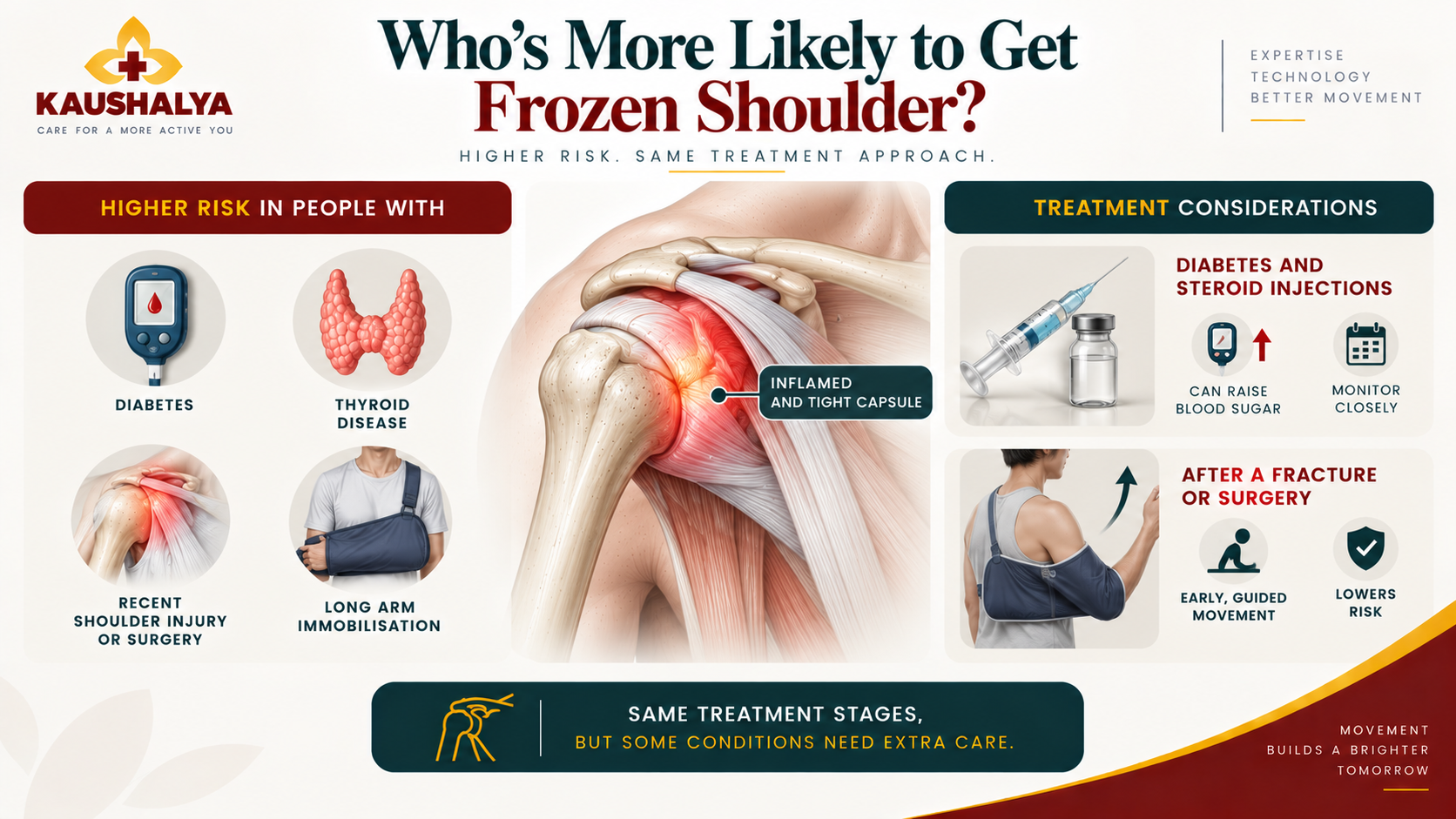
People with diabetes, thyroid disease, recent shoulder injury or surgery, or long arm immobilisation are more likely to get frozen shoulder, and diabetic patients often recover more slowly. Treatment follows the same stages, but blood sugar control and steroid use need extra care.
Diabetes and steroid injections
Steroid injections can raise blood sugar for a few days. That doesn’t rule them out, but you should monitor more closely and tell your doctor about your sugar control beforehand.
After a fracture or surgery
If your arm was in a sling for weeks, early, guided movement afterwards reduces the chance of the capsule stiffening.
Wrapping up
Frozen shoulder treatment isn’t one thing. It’s a sequence: calm the pain early, protect movement while it’s freezing, stretch hard once it’s frozen, and rebuild strength while it thaws. If months of proper treatment haven’t moved the needle, a release procedure is a reasonable next step, not a failure. And “wait and see” should always come with a plan.
Kaushalya Medical Foundation Trust Hospital, a 150-bed trust hospital in Thane West, runs a full orthopaedic surgery department in Thane West, offering shoulder arthroscopy alongside physiotherapy and non-surgical joint care, so the stage-by-stage plan can stay with one team from the first injection to the final strengthening phase. If your shoulder’s been stiff for more than a few weeks, book an orthopaedic consultation and find out which stage you’re in.
FAQs
What is the best treatment for frozen shoulder?
It depends on the stage. Early on, pain control and a steroid injection help most. In the stiff stage, stretching-focused physiotherapy works best. If stiffness persists despite months of treatment, manipulation or arthroscopic release may be advised.
How long does frozen shoulder last?
Most people improve within 6 to 18 months, and the full cycle can take up to two years or longer. Some people are left with mild stiffness, which is why active treatment is worth it rather than simply waiting.
Does frozen shoulder go away on its own?
Not reliably. A systematic review found no evidence that frozen shoulder always resolves fully without treatment. Untreated shoulders improved partially over one to four years, with most gains happening early.
Is a steroid injection good for frozen shoulder?
Yes, especially in the early painful stages. It reduces inflammation and night pain, helping you sleep and move. It’s less useful once stiffness dominates. People with diabetes should monitor blood sugar for a few days afterwards.
When is surgery needed for frozen shoulder?
Surgery is considered when stiffness persists after several months of proper conservative treatment. Options include manipulation under anaesthesia and arthroscopic capsular release, both followed by early physiotherapy to keep the regained movement.
Can I exercise with frozen shoulder?
Yes, but match it to the stage. Gentle range-of-motion exercises suit the painful early stage. Firmer stretching suits the frozen stage. Strengthening suits the thawing stage. Exercise that leaves you sore for hours is too much.