

By Kaushalya Medical Foundation Trust Hospital | Medically reviewed by a consultant orthopaedic surgeon
Hip replacement surgery in Mumbai is usually presented to you as a single decision, yes or no, followed by a quote. It is actually four decisions: the bearing surface the joint runs on, how the implant is fixed to your bone, the size of the femoral head, and the approach the surgeon cuts through. Each one has a trade off, and each one is being made whether you are told or not.
Key insights
- Your implant has four choices, not one product: bearing surface, fixation, head size and approach are decided separately, and any of them can be wrong for you while the others are right.
- Age and bone quality drive most of it: the same hip in a 52 year old and a 79 year old sensibly gets different answers to at least two of the four.
- Bigger heads buy stability and cost something else: registry and meta-analysis work has gone back and forth on where the balance sits.
- The approach matters least of the four, long term: it changes your first six weeks far more than it changes your next fifteen years.
Before your consultation
Take the quote you were given and ask which implant it assumes, cemented or uncemented, and what changes if the surgeon finds softer bone than expected on the day. A surgeon who has planned properly will answer in about a minute. If the answer is vague, that is information too.
Most people who come in for a second opinion on a hip have already been through one consultation and come out holding a sheet of paper with a total on it. They know roughly what it costs and roughly how long they will be in hospital. What they almost never know is that the surgeon has already picked four different things on their behalf, and that a different surgeon might have picked differently for perfectly good reasons.
This is not a scandal. There is no time in a busy clinic to teach implant engineering, and most patients would not want the lecture anyway. But there is a real gap between “you need a hip replacement” and “here is what I am putting in you, and here is why”, and that gap is where most of the anxiety lives.
What follows is the four decisions in plain language, what actually swings each one, and the questions that get you a real answer without needing to understand a single thing about metallurgy.
Why nobody explains this to you
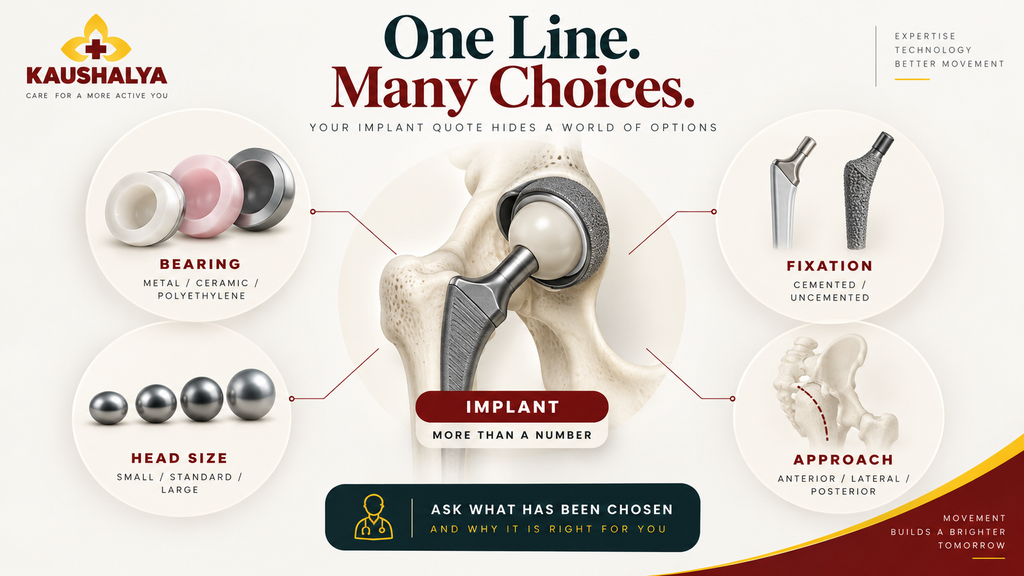
The quote hides the choices inside a single line
Most hospital estimates carry one line that says implant. That single figure can sit across a wide range of bearing and fixation combinations, which is why two quotes for the same operation can differ without either hospital doing anything dishonest.
What to ask instead
You do not need to choose. You need to know what has been chosen. “Which bearing, cemented or not, what head size, which approach, and why those for me” is one sentence and it gets you the whole picture.
The four decisions, at a glance
| Decision | What it means | What mainly drives it |
| Bearing surface | The two materials that rub against each other inside the new joint | Your age, your activity level, expected lifespan of the implant |
| Fixation | Whether the implant is cemented into bone or pressed in for bone to grow onto | Bone quality, age, sometimes what is found during surgery |
| Femoral head size | The diameter of the ball that sits in the new socket | Stability needs, socket size, dislocation risk, wear concerns |
| Surgical approach | The route taken through muscle to reach the joint | Surgeon training and volume, your body shape, previous surgery |
Decision one: the bearing surface
What it actually is
A hip replacement is a ball in a socket. The bearing surface is the pair of materials where those two meet. In current practice the common combinations are ceramic on polyethylene, metal on polyethylene, and ceramic on ceramic. Polyethylene here is not ordinary plastic, it is a highly cross linked medical grade material engineered specifically to resist wear.
Why anybody cares
Every bearing wears. The particles that wear off are the long term problem, because the body reacts to them and that reaction can loosen an implant that was otherwise fine. Slower wear means a longer working life, which matters enormously in a 55 year old and matters much less in an 82 year old.
How age changes the answer
| Patient profile | Common reasoning |
| Under 60, active, long life expectancy ahead | Wear resistance is the priority, because the implant has to last decades |
| 60 to 75, moderate activity | The middle of the range, where most standard combinations are reasonable |
| Over 75, lower demand | Predictability and immediate stability usually outrank theoretical wear rates |
| Previous hip problems or revision surgery | The choice narrows sharply and is made on what the bone and socket will accept |
Bearing choice also feeds into stability. In an analysis of registry data, ceramic on ceramic bearings carried a different revision risk for dislocation than ceramic on polyethylene once head size and patient factors were accounted for, which is a good illustration of why these four decisions cannot be taken one at a time in isolation.
Decision two: fixation, cemented or uncemented
What cement does
Bone cement is an acrylic that sets in minutes and grips the implant to the bone immediately. Uncemented implants have a textured or coated surface that bone grows into over the following weeks, which gives a biological bond rather than a mechanical one.
Bone quality usually decides it
A dense, strong bone holds an uncemented implant well. Softer, more osteoporotic bone, which is common in older patients and particularly in post menopausal women, often holds a cemented implant far more reliably. This is why the same surgeon will genuinely do it differently in two patients on the same list.
The hybrid option, and the day of surgery
| Configuration | What it means |
| Fully cemented | Both the stem and the socket are cemented |
| Fully uncemented | Both rely on bone ingrowth |
| Hybrid | Cemented stem with an uncemented socket, a common compromise |
| Decided intraoperatively | The plan is set, but the surgeon retains the option to change if the bone found is not what the scan suggested |
That last row is the one worth asking about. A surgeon who has both options available in theatre is better placed than one committed to a single plan.
Decision three: femoral head size
The stability argument
A larger head has to travel further before it can pop out of the socket, which is described in the literature as jump distance, and it has a wider arc of movement before the components collide. Both of those push in the direction of fewer dislocations.
The trade off
Larger heads sit in thinner liners and generate more surface contact, which raises questions about polyethylene wear, liner fracture and corrosion at the junction between head and stem. A systematic review and meta-analysis comparing 36 mm against 32 mm heads on polyethylene liners sets out exactly this tension, and it is not fully settled.
Where this sits in real numbers
Dislocation is rare either way. In one large registry series of primary hip replacements performed for osteoarthritis, 0.78 per cent were revised because of dislocation. That is a small number, but it is also the complication patients fear most vividly, and it is the one head size is chosen to manage.
Decision four: the surgical approach
The three routes
| Approach | Route | Commonly cited trade off |
| Posterior | From behind the hip | Widely used, excellent exposure, historically associated with more dislocation risk, largely mitigated by modern repair technique |
| Direct anterior | From the front, between muscle planes | Often quicker early mobility, technically demanding, learning curve is real |
| Lateral | From the side | Very stable, can affect the abductor muscles and gait in some patients |
What actually matters here
The approach changes your first six weeks a great deal and your next fifteen years much less. The single most important variable is not which approach, it is how many of that approach your surgeon does. A surgeon performing a familiar approach well will out-perform the same surgeon attempting a fashionable one.
What these four do to your estimate
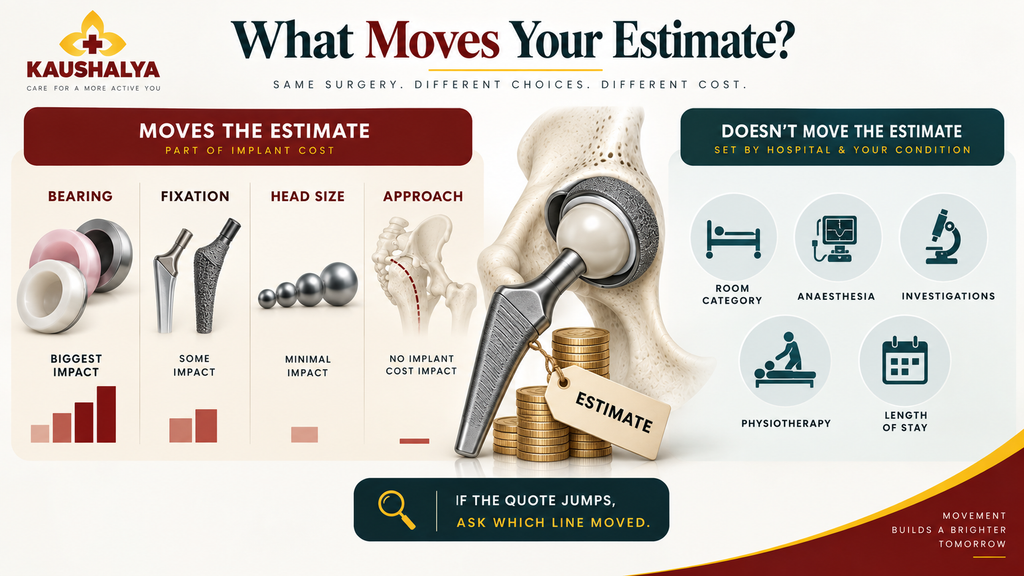
Where the money actually moves
Implant selection is the line most sensitive to these decisions, and bearing choice is the biggest single mover inside it. Fixation shifts it a little. Head size barely shifts it at all. Approach does not change the implant cost but can change theatre time.
Where it does not move
Room category, anaesthesia, investigations, physiotherapy and length of stay are set by the hospital and your medical condition, not by the implant. If a revised quote jumps, ask which line moved.
What none of the four can fix
Surgeon and unit volume
The implant does not operate on you. Consistent results come from teams that do this work often, have a rehearsed pathway, and have seen the uncommon problems before.
Your rehabilitation
A well chosen implant placed perfectly still needs you to do the work afterwards. Most of the difference between an adequate outcome and a very good one at six months is built in physiotherapy, not in theatre.
Your own risk factors
Weight, diabetes control, smoking, dental infection and bone density all sit outside the implant conversation and all affect how this goes. Several of them are modifiable in the weeks before surgery, which is the most underused window in the whole process.
Taking this into your consultation
The five questions
- Which bearing surface are you planning for me, and why that one at my age?
- Cemented, uncemented or hybrid, and what would make you change on the day?
- What head size, and what does that do to my dislocation risk?
- Which approach do you use, and how many hips do you do a year?
- Can I have the estimate itemised with the implant on its own line?
What good answers sound like
Specific, quick and tied to you personally. A surgeon who says “uncemented stem because your bone stock on the scan is good, and I would switch to cemented if it feels soft” has told you they have a plan and a fallback.
Wrapping up
The reason nobody explains the implant is not that it is a secret. It is that the conversation has never been structured for patients, so it gets skipped, and people go into one of the biggest operations of their lives knowing the price of the thing and nothing about it. You do not need to make these four choices. You need to know they exist, know roughly what pulls each one in which direction, and be able to ask a surgeon to talk you through the reasoning in plain words.
The orthopaedic team at Kaushalya Medical Foundation Trust Hospital performs hip replacement using minimally invasive technique within a 150 bed tertiary care hospital in Thane, with four consultant orthopaedic surgeons covering joint replacement, trauma, spine and paediatric orthopaedics between them.
If you are holding a quote and are not sure what is inside it, bring it in. A consultation with the orthopaedic surgery department, or a look at the consultant team and their areas of practice, is a sensible next step before anything is signed.
FAQs
How long does a hip replacement implant last?
Modern implants are commonly expected to function for well over a decade and frequently far longer, but the honest answer is that it depends on your age, your weight, your activity and the bearing chosen. Younger and more active patients should plan on the possibility of revision at some point.
Is a cemented or uncemented hip better?
Neither is better in general, they are better for different bones. Uncemented fixation relies on bone growing into the implant, which needs reasonable bone quality. Cemented fixation grips immediately and is often preferred in softer or osteoporotic bone, which is more common with age.
Does a bigger femoral head reduce dislocation risk?
Larger heads increase the distance the joint must travel before dislocating and widen the range of movement before impingement, which argues for fewer dislocations. The counterweight is concerned about polyethylene wear and taper corrosion, and the literature comparing sizes is still working the balance out.
Which hip replacement approach is best?
The one your surgeon does most often and does well. Anterior, posterior and lateral approaches all produce good long term results. Approach mainly changes the first weeks of recovery rather than the long term function of the joint.
Why do two hospitals quote very different amounts for the same hip replacement?
Usually because the implant assumed is different, and occasionally because room category, physiotherapy or length of stay have been cost differently. Ask both for an itemised estimate with the implant on a separate line and the comparison becomes real.
Can I ask my surgeon how many hip replacements they perform?
Yes, and you should. It is a normal question, a reasonable surgeon will answer it without any awkwardness, and it is more useful to you than almost any detail about the implant itself.